Late-Flowering Plants That Bloom Through Winter Frost
Okay so here’s what nobody tells you about fall gardening. Everyone acts like once September hits, your garden is basically done until next spring. Like you’re supposed to just accept brown mums and call it a season.
But that’s actually complete BS. There are plants that literally bloom better in cold weather than they do in summer. Some of them will keep flowering right through frost, snow, and into December or January depending on where you live.
I spent years thinking my garden had to look depressing from October through May. Then one year I got tired of staring at nothing but brown stems and dead leaves, and I actually started researching what blooms late. Not just googling “fall flowers” and getting the same mum recommendations everywhere, but like actually reading university extension research and plant studies.
Turns out I’d been missing out on months of potential color because I didn’t know what I was doing. And most of the advice online is either super basic (“plant pansies!”) or just wrong about what actually survives cold weather.
So this is everything I figured out about keeping your garden looking decent way past when everyone else’s gardens have given up.
Why Some Plants Wait Until Fall to Bloom (It’s Not Random)
So there’s actually real science behind why certain plants bloom late. They’re not just slow – they evolved specific biological triggers.
Chrysanthemums are what botanists call “short-day plants” which basically means they won’t even start making flowers until daylight drops below 14 hours per day.[1] They have these photoreceptor proteins – phytochromes – that literally count hours of darkness. Only when nights get long enough do they finally go “okay time to bloom.”[1]
Which is kind of cool when you think about it. The plant is basically using darkness as a calendar.
Temperature matters just as much though. Pansies and snapdragons don’t just tolerate cold – they actually prefer it. Research shows they perform their best when nighttime temps are in the 40s and daytime stays between 60-75°F.[2] Heat makes them stop blooming entirely or just die back, which is why spring pansies always look terrible by June no matter what you do.
Climate Change Is Actually Messing With Bloom Times
Something interesting I read recently – Missouri Botanical Garden published research in 2025 showing that native plants are now flowering 11.5 days longer on average compared to historical records.[3] Black-eyed Susans that used to quit blooming in early October are now going into Halloween in a lot of regions.
So all those old gardening books with their strict planting dates might be too conservative now. Plants can actually handle more than they used to.
Pansies Are Way Tougher Than They Look
People treat pansies like they’re delicate because of how the flowers look. But they’re actually shockingly hardy.
Like I’m talking established pansies can survive temperatures as low as -10°F as long as the soil itself isn’t frozen solid.[4] That’s way colder than most people realize. Penn State Extension did testing on this and found the cold tolerance starts at the roots – they need to be planted when soil temps are between 45-65°F, which is usually late September to October depending on your zone.[5]
The problem is people plant pansies at the wrong time or in the wrong conditions and then blame the plant when it doesn’t work.
What Actually Happens at Different Temps
Here’s what the research shows happens at specific temperatures:
Around 25°F – flowers and foliage wilt and turn grayish but the plant usually recovers once it warms up[6]
Around 20°F for a few hours – you’ll get some damage but established plants bounce back[6]
Below 10°F for extended periods – this is where you start losing plants, especially in exposed locations[7]
University of Georgia did this study where they measured soil temps in the same pansy bed.[8] The south-facing side was 45°F while the north-facing side like 10 feet away was frozen solid. The south-facing pansies were totally fine. The north-facing ones died because their roots couldn’t pull water through frozen soil even though the air temp was the same for both sides.
So location and sun exposure matters way more than just “what’s the air temperature.”
I plant pansies in late September now. End of October if I’m in a warmer zone. Not the night before the first frost like I used to do in a panic. Give them time to get roots established before hard freezes hit and they’ll last way longer.
Not All Pansies Are Created Equal
The ‘Icicle’ series was specifically bred for extreme cold and consistently outperforms regular varieties in northern zones.[5] If you’re in zone 6 or colder, get these.
The ‘Majestic Giants’ and ‘Crown’ series have better heat tolerance but they’re not as cold-hardy.[8] So know what you’re buying.
Also container pansies are less hardy than ground-planted because soil in pots freezes faster. Keep that in mind if you’re doing container gardens – you might need to bring them in during really cold snaps.
Snapdragons Are Actually Perennials (Which Nobody Tells You)
Most people don’t know this but snapdragons are Mediterranean perennials that we just treat like annuals.[9] In zones 7-11 they’ll actually come back year after year if you don’t kill them.
And they’re way more cold-tolerant than anyone realizes. University of Georgia Extension specifically says once snapdragons are established and hardened off, they “can withstand sub-freezing temperatures.”[10] Like they tested this.
Research from growers in cold climates shows seedlings can handle temps down to 23°F with cover, and mature plants survive down to 14°F.[11] That’s legitimately frost-hardy.
What They Actually Need to Thrive
Best conditions for snapdragons:
- Nighttime temps around 50°F
- Daytime 60-75°F
- Full sun (minimum 6 hours)
- Well-drained soil with tons of organic matter worked in[10]
They get all leggy and stop blooming in heat – anything consistently above 80°F stresses them out.[12] But cold? They love it.
For fall planting, UGA Extension recommends working 2 pounds of slow-release 12-6-6 fertilizer per 100 square feet plus 3-4 inches of organic matter mixed into the top 8-10 inches of soil.[10] Deadhead regularly and they’ll just keep blooming.
If you get a really nasty cold snap – like below 20°F – throw some pine straw over them for a few days. Pull it off once temps moderate.[10]
Varieties That Work Best
Tall varieties like the ‘Rocket’ series grow up to 36 inches and make great cut flowers. Dwarf types like ‘Floral Showers’ stay around 8 inches – better for containers or front of borders.[13]
The ‘Crown’ series in Terra Cotta mix is supposedly gorgeous – rust orange with creamy yellow.[10] Trailing varieties like ‘Luminaire’ series work well in hanging baskets.
Ornamental Kale Gets MORE Colorful When It’s Cold
This is one of the weirdest things about ornamental kale – it actually looks better the colder it gets. Like the opposite of normal plants.
The purple, pink, red, and white colors in the leaves intensify when nighttime temps drop below 50°F.[14] It’s a pigment response to cold stress. So while everything else is fading, ornamental kale is getting more vibrant.
And it’s incredibly hardy. NC State Extension confirms established ornamental kale can survive down to 5°F.[14] That’s zone 2-11 territory. It’ll last well into January in most places.
It’s Not Really “Kale” Though
Technically ornamental kale is the same species (Brassica oleracea) as edible kale but it’s been bred for looks not taste.[15] It’s a biennial grown as an annual – the true flowers only show up year two, and at that point it looks terrible so you pull it.[15]
The leaf colors are what you want. ‘Nagoya’ series has heavily crinkled leaves in bright fuchsia and purple. ‘Peacock’ series has deeply cut feathery foliage.[14] Both are insanely hardy.
Plant in late summer for fall color. They like full sun and slightly acidic soil. Main thing is keeping them watered – they’ll wilt fast if they dry out, especially in containers.
Space plants 12-18 inches apart and bury the stems so the lowest leaves sit right at soil level.[14] They look way better planted in groups than scattered around randomly.
Witch Hazel Blooms When Literally Nothing Else Will
American witch hazel (Hamamelis virginiana) is one of the weirdest native shrubs because it flowers in autumn while everything else is preparing for dormancy.
October through December it produces these fragrant yellow spider-like blooms just as its fall foliage drops.[16] The effect is striking – bare branches covered in delicate yellow flowers while everything else is brown.
The Flowers Have This Cool Cold Adaptation
The flowers have strap-like petals that curl up tight on cold days to protect the reproductive parts, then unfurl when it warms up.[17] So they can handle frost events that would kill most flowers.
Individual blooms can last up to 8 weeks because of this.[17] They’re not surviving cold, they’re designed for it.
American witch hazel is native zones 3-8, meaning it handles temps as low as -35°F.[18] It tolerates shade, wet soils, pollution, deer browsing – basically impossible to kill. It’s a native plant that actually thrives on neglect.
Hybrid Witch Hazels Bloom Even Earlier
If you want winter color instead of fall, hybrid witch hazels (H. × intermedia) bloom February-March. ‘Arnold Promise’ has bright yellow flowers and is super fragrant. ‘Diane’ has red flowers that age to copper.[17]
The hybrids aren’t as fragrant as American witch hazel though. And they need more sun – partial shade instead of full shade.
Plant witch hazel in moist, acidic, humus-rich soil.[16] Add 2-4 inches of mulch to keep moisture consistent. They grow 10-20 feet eventually but you can prune them smaller.
Important – prune in early spring after flowering since blooms form on old wood. If you prune in fall you’re cutting off next year’s flowers.
Mahonia ‘Winter Sun’ Blooms Straight Through December
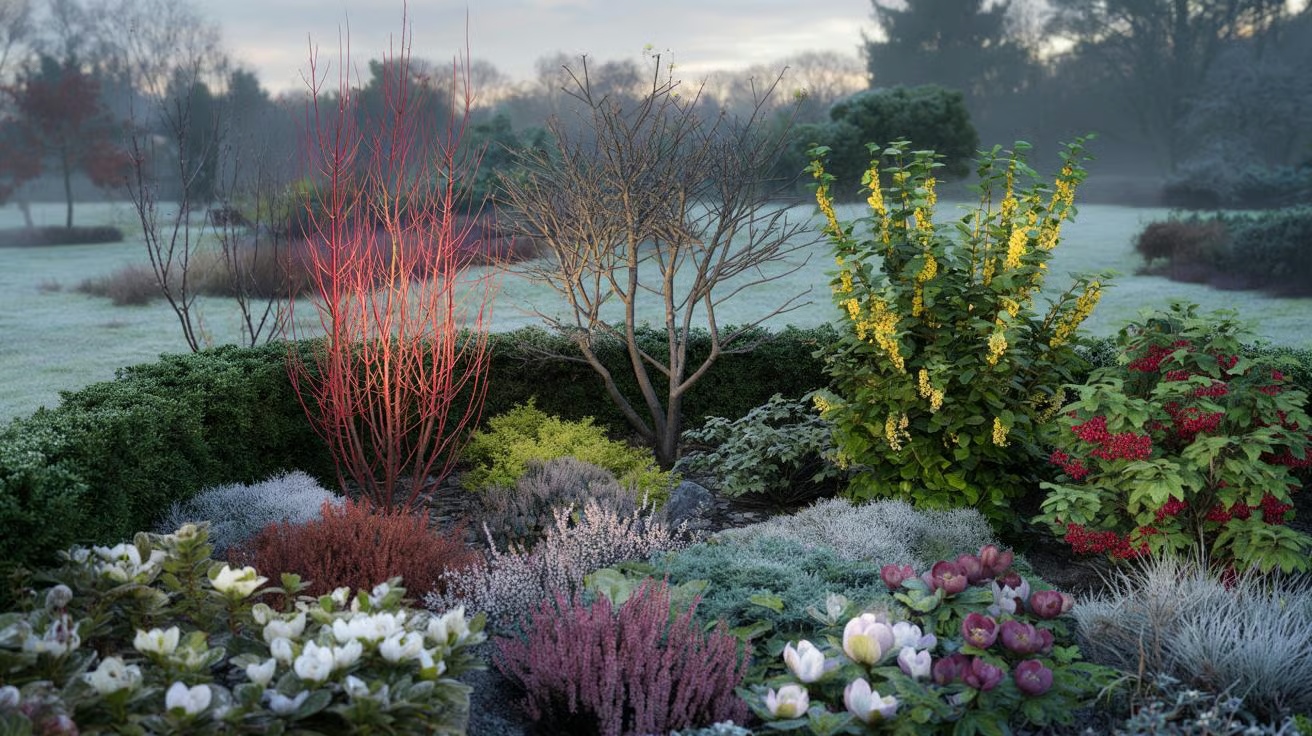
When everything else has gone completely dormant, mahonia (Mahonia × media ‘Winter Sun’) erupts with bright yellow flower spikes starting in November and continuing through February.[19]
The contrast against the dark evergreen holly-like foliage is dramatic. Plus it’s fragrant, which is rare for winter bloomers.
This hybrid was developed at Slieve Donard Nursery in Ireland around 1966.[20] It grows 6-10 feet tall and 4-6 feet wide if you don’t prune it.[20] Hardy zones 5-9, tolerates temps down to about 5°F with wind protection.[21]
It Actually Prefers Shade
Unlike most flowering shrubs, mahonia performs best in partial to full shade.[22] In hot climates afternoon sun scorches the leaves. Morning sun with afternoon shade is ideal.
Prepare planting sites with 3-4 inches of organic matter and 5-10-5 fertilizer worked into the top 8-10 inches.[23] Once established it has basically no pest or disease problems.
The flowers are followed by waxy blue-black berries that birds love. Note – berries contain berberine and aren’t edible for humans. They’re ornamental only.
The foliage turns purplish-bronze in cold weather too, so you get winter interest even before blooms show up.[19]
Mums and Asters (The Classic Fall Bloomers Everyone Knows)
Can’t talk about late-season flowers without mentioning chrysanthemums and asters. Both are short-day plants triggered to bloom by decreasing daylight.[1]
Garden Mums vs Grocery Store Mums
There’s a huge difference most people don’t know about. Korean Hybrid mums are actually perennial in zones 3-9 if you plant them in spring and let roots establish.[24]
The massive exhibition mums you get at grocery stores in September? Those are basically one-season plants bred for maximum flower size, not winter survival. They rarely come back.
If you want mums that return, look for varieties labeled “garden hardy” or the ‘Mammoth’ series.[24] But you have to plant them in spring, not fall. Fall-planted mums almost never survive their first winter because roots never get established before freeze.
Asters Got Reclassified (But They’re Still Great)
The asters everyone knows got renamed by botanists. New England aster is now properly called Symphyotrichum novae-angliae.[25] Still the same plant, just different genus name.
These native plants bloom September through late October and are critical for late-season pollinators.[25] Migrating monarchs depend heavily on fall asters for fuel when there’s not much else blooming.
Way easier to grow than mums too – basically zero maintenance once established. Full sun, decent drainage, done. Zones 4-8 typically.
How to Actually Extend the Season (Beyond Just Plant Choice)
Even super frost-hardy plants benefit from protection during extreme cold. These methods actually work:
Row Covers Add 2-8°F
Floating row covers can raise temps just enough to protect plants during brief cold snaps.[26] The key is supporting them with hoops so fabric doesn’t touch foliage directly – frost can still damage leaves at contact points.
Lightweight covers add about 2°F. Heavy covers add 6-8°F. That’s often enough to get plants through a 28°F night without damage.
Mulch Timing Is Critical
Don’t mulch until after the first hard frost once the ground has frozen.[26] Mulching too early traps warm soil temps and prevents plants from properly hardening off.
Once ground is frozen, apply 4-6 inches of straw, shredded leaves, or pine needles around plants.[26] Keep mulch several inches away from stems to prevent rot.
Pine straw is better than heavy bark mulch for pansies and similar plants because it’s lightweight and lets water filter through.[27]
Location Matters More Than You Think
South-facing positions against walls benefit from radiant heat. Low-lying areas where cold air settles – “frost pockets” – should be avoided for marginally hardy plants.[26]
Even within the same bed, south-facing slopes can be 10-20°F warmer at soil level than north-facing slopes.[8] That’s a massive difference.
Containers Are Way Less Cold-Hardy
Container roots are about 20°F less cold-hardy than the same roots growing in the ground.[26] The soil mass provides insulation that pots just don’t have.
So a pansy that survives 10°F in ground might only handle 30°F in a pot. Plan accordingly.
You can cluster pots together for mutual warmth, move them against house walls during cold snaps, or bring them into garages when temps really drop.
What I’d Actually Do If Starting Over
After screwing this up for years and then figuring it out, here’s what I’d do if starting fresh:
September:
- Plant pansies and ornamental kale in late September (zones 6-7) or early October (zones 7-8)
- Get snapdragons established before frost
- Plant witch hazel or mahonia if doing shrubs (these take longer to establish)
October:
- Mulch once ground starts freezing, not before
- Make sure everything’s well-watered before first hard freeze
- Set up row covers for tender stuff if needed
November-December:
- Reapply mulch if it blows away
- Water during warm spells (plants still need moisture)
- Enjoy the blooms while everyone else has a brown yard
What I wouldn’t do:
- Buy cheap grocery store mums expecting them to come back (they won’t)
- Plant pansies the night before a frost and wonder why they struggle
- Skip the mulch and expect plants to be fine in zone 6 or colder
- Try to keep summer annuals going (just let them go)
- Expect perfect blooms through blizzards (be realistic)
The Hardiness Zone Thing Everyone Gets Wrong
Everyone obsesses over hardiness zones but honestly most people don’t understand what they actually mean.
Zones tell you the average annual minimum temperature. Zone 6 = -10 to 0°F. Zone 7 = 0 to 10°F. That’s it.[28]
But zones don’t tell you:
- How long cold lasts
- Soil conditions
- Microclimates in your yard
- Snow cover (which insulates)
- Wind exposure
You can have zone 6 conditions in a zone 7 area if you’re in a wind tunnel with no snow. Or zone 7 conditions in zone 6 if you’re on a south-facing slope against a brick wall.
Pay attention to your actual conditions, not just the zone on a map.
Different Plants for Different Zones
Zones 4-5 (really cold): Focus on the super hardy stuff – New England asters, sedum ‘Autumn Joy’, hardy mums (garden types), ornamental kale. Pansies with heavy mulch. Witch hazel absolutely.
Zones 6-7 (moderate): All of the above plus snapdragons, most pansies without crazy protection, mahonia. Hellebores start being reliable here.
Zones 8-9 (mild winters): Everything mentioned plus camellias, winter jasmine, winter daphne. You can keep tropical salvias and Mexican bush sage blooming year-round with minimal effort.
Zones 10-11 (barely winter): Honestly you guys can grow whatever. The challenge isn’t cold, it’s heat in summer.
When It’s Actually Worth the Effort vs When to Just Accept Brown
Real talk – not everything is worth overwintering. Some plants are just annuals and trying to keep them alive all winter is more hassle than it’s worth.
Basil? It’s an annual. Just accept it. Take cuttings if you want, but trying to overwinter the plant itself is pointless.
Tropical hibiscus in zone 6? Probably not worth it unless you have a greenhouse.
But pansies, snapdragons, ornamental kale, witch hazel, mahonia – these are plants that actually thrive in cold weather. You’re not fighting their nature, you’re working with it. That’s the difference.
Bottom Line
The research backs up what experienced gardeners figured out through years of trial and error. Certain plants are programmed to bloom late. They have biological mechanisms specifically for cold weather.
The trick is:
- Choosing actually cold-hardy varieties (not all pansies are equal)
- Planting early enough for roots to establish (September, not November)
- Proper mulching after ground freezes
- Understanding your actual microclimate
Do those things and you can have a garden that still looks intentional in December while everyone else’s is brown and depressing.
Way more satisfying than just giving up for six months.
Sources:
[1] Blanchard, M.G., & Runkle, E.S. (2006). Photoperiodism in flowering plants. Journal of Experimental Botany.
[2] Greenhouse Product News. (2021). “Cool Temps and Bright Light Treat Pansies Right.”
[3] Missouri Botanical Garden. (2025). “Native Plant Flowering Times Extended by Climate Change.” Research blog.
[4] Arizona State University Plant Database. Viola × wittrockiana cold tolerance specifications.
[5] Penn State Extension. “Extend the Season with Resilient Pansies.”
[6] Gardening Know How. (2021). “Can You Grow Pansies In Winter.”
[7] New Garden. (2025). “How Extreme Cold Affects Pansies, Violas, Cabbage and Kale.”
[8] University of Georgia Extension, Wade, G.L. (2025). “Success with Pansies in the Winter Landscape.”
[9] Royal Horticultural Society. Antirrhinum majus classification.
[11] Shifting Roots. (2025). “How to Grow Snapdragons in a Cold Climate.”
[12] Gardener’s Path. (2022). “How to Overwinter Snapdragons.”
[13] SF Gate Home Guides. (2021). “Is a Snapdragon Frost Resistant?”
[14] NC State Extension. (2025). “Brassica Oleracea (Ornamental Cabbage and Kale).”
[15] Wisconsin Horticulture. “Ornamental Cabbage and Kale.”
[16] Lady Bird Johnson Wildflower Center.Hamamelis virginianadatabase.
[17] Iowa State University Extension. “All About Witch Hazels.”
[18] USDA PLANTS Database. Hamamelis virginiana hardiness zones.
[19] NC State Extension Plant Toolbox. “Berberis × hortensis ‘Winter Sun’.”
[20] Royal Horticultural Society. Mahonia × media cultivar history.
[21] The High Line. (2018). “Plant of the Week: Winter Sun Mahonia.”
[22] Keeping It Green Nursery. “Mahonia × media ‘Winter Sun’.”
[23] Mississippi State Extension. “Plant Mahonia For Year-round Appeal.”
[24] American Horticultural Society. Chrysanthemum cultivation guidelines.
[25] USDA PLANTS Database. Symphyotrichum reclassification.
[26] Clemson University HGIC. (2024). “Season Extension and Frost Protection.” December 2024.
[27] University of Georgia Extension. Pine straw mulching guidelines.
[28] USDA Plant Hardiness Zone Map. Official zone definitions.