Why Landscape Fabric Fails (+ Better Alternatives That Work)
Look, I get it. Landscape fabric seems like such a smart solution. You put it down, cover it with mulch, and supposedly never deal with weeds again. That’s what the garden center told me anyway.
Except it doesn’t work like that. Not even close.
I’ve used landscape fabric in three different garden beds over the years and every single time it turned into a maintenance nightmare. Weeds everywhere, soil that looked like concrete underneath, and eventually I’m out there trying to rip up this tangled mess of fabric and roots while questioning my life choices.
So after the third time screwing this up, I started actually reading research on this stuff. And it turns out there’s a reason every horticulture professor seems to hate landscape fabric. The science shows pretty clearly why it fails, and more importantly, what actually works instead.
Here’s what I figured out.
The Problem with Landscape Fabric (Backed by Actual Science)
It Kills Your Soil
This is the big one that nobody talks about enough. Landscape fabric doesn’t just sit there harmlessly – it actively damages your soil over time.
There’s research from Washington State University that measured how different materials affect gas exchange in soil.[1] They found landscape fabric reduces the movement of carbon dioxide and oxygen between soil and air by about 1,000 times compared to regular wood chip mulch. One thousand times.
Your soil needs to breathe. There’s this whole ecosystem of microbes and fungi and earthworms down there that need oxygen. When you cut off gas exchange like that, everything underground basically suffocates slowly.[2]
Penn State Extension documented what happened after 20 years of landscape fabric in one garden. The extension agent pulled up the fabric and described the soil underneath as “moist pottery” – it was so compacted and lifeless it didn’t even look like soil anymore.[3]
And it’s not just one study. University of Illinois Extension talks about how the fabric pores get clogged with dirt and decomposing mulch, making it even less permeable over time. One extension agent literally pulled up fabric after a heavy rain and found bone-dry soil underneath because water couldn’t penetrate anymore.[4]
The Weed Control Stops Working
Here’s the ironic part – the main reason people use landscape fabric is weed control, but that only works for like 2-5 years max.
What happens is the mulch on top of the fabric slowly breaks down. That decomposing mulch creates a thin layer of soil on top of the fabric. And guess what loves to grow in that? Weeds.
North Carolina State research going back to the 1980s showed that landscape fabric covered with organic mulch becomes just as weedy as if there was no fabric at all.[5] The weeds aren’t even growing through the fabric half the time – they’re growing IN THE MULCH ON TOP OF IT.
And when weeds do push roots through the fabric? Good luck pulling them out. I had this experience with thistles and dandelions in one bed. Their roots went through the holes in the fabric and then I literally could not get them out. Pulling just broke off the tops. The roots stayed put and kept growing.[3]
It Gets Really Expensive Long-Term
One cubic yard of decent landscape fabric costs around $50-85 depending on quality. For a 500 square foot bed you’re looking at $550-1,200 for initial installation with stone on top.[6]
But here’s what they don’t tell you – that’s not a one-time cost. After 5-7 years the fabric starts breaking down (especially if any of it’s exposed to sun). When it fails you have to remove everything, pull up shredded fabric, and start over.
Compare that to organic mulch at around $175-270 to cover the same area initially, then $70-135 yearly to refresh it. Over 10 years organic mulch costs about $800-1,500 total versus $1,500-2,700+ for fabric that you’ll need to replace and probably deal with weeds on top of anyway.[6]
And the National Gardening Association found 78% of gardeners who used landscape fabric said it didn’t successfully prevent weed growth after 2 years.[6] So you’re paying more to get worse results.
It’s Creating Microplastic Pollution
This one honestly freaked me out when I learned about it.
Research from Australia looked at landscape fabric that had been in a garden for 7 years. They found it was degrading into millions of tiny plastic fragments – microplastics.[7] For just one square meter of fabric, the amount of microplastics released was in the hundreds of millions.
And those microplastics don’t go anywhere. They stay in your soil basically forever, affecting soil structure, water retention, and the organisms living there.[8] Recent research shows microplastics can persist in soil for thousands of years.[9]
So even after you remove the fabric, the damage continues.
What Actually Works: Organic Mulch
Okay so if fabric doesn’t work, what does?
Turns out the answer is almost stupidly simple – just use organic mulch. That’s it. No fabric underneath, just mulch directly on the soil.
The Science on Why This Works
Multiple university studies have compared different mulch types for weed suppression. Here’s what actually matters:
Depth – This is the big one. Research from UC Ventura Extension found that 3-6 inches of organic mulch blocks weeds just as effectively as landscape fabric.[10] The key is getting enough depth to prevent light from reaching the soil surface so seeds can’t germinate.
One inch of mulch? Basically useless. Weeds can push through that no problem. But 3-4 inches blocks nearly all light and creates a physical barrier that seedlings can’t penetrate.
How it blocks weeds:
- Prevents light from reaching soil (stops photosynthesis and germination)
- Creates nitrogen deficiency at the surface that inhibits seedling survival[11]
- Physical barrier prevents root development
- Some mulches have natural compounds that inhibit seed germination[12]
Temperature and moisture benefits – Studies show organic mulch reduces daily soil temperature swings by 1.6-2.1°C and can reduce water evaporation by 28-58%.[13] Your plants actually grow better, not just fewer weeds.
Different Mulch Types and What Works Best
I’ve tried basically everything at this point. Here’s what I learned (backed by actual research):
Wood chips – Michigan State University ranked these as one of the best mulch choices in a 15-mulch comparison study.[14] They break down slowly (4-5 years for hardwood), suppress weeds well, and improve soil over time.
The “wood chips steal nitrogen” thing is mostly a myth by the way. University of Saskatchewan research showed nitrogen depletion only happens in a thin layer right at the mulch-soil interface, not in the root zone where your plants are.[15] And that thin nitrogen-poor layer actually helps suppress weed seeds.
I get free wood chips from arborists through ChipDrop when they’re working in my area. Way better than buying bagged mulch.
Bark mulch – Lasts even longer than wood chips, 7-10 years typically. More expensive but you don’t have to replace it as often. Good choice if you want something that looks nicer than random wood chips.
Pine needles – These are great if you can get them. They don’t compact or blow away like other mulches. They last about 2 years before you need to add more.
And the “pine needles make soil acidic” thing? Another myth. Fresh pine needles are acidic (pH 3.2-3.8) but as they decompose organisms neutralize them. Oregon State and University of New Hampshire both confirmed a 2-3 inch layer of pine needle mulch won’t measurably change your soil pH.[16][17]
Shredded leaves – Basically free if you have trees. Break down fastest (6-12 months) so you’ll need to refresh often, but they’re excellent for soil improvement. Just run them over with a mower first so they don’t mat down.
Grass clippings – Free and nitrogen-rich, but only use thin layers (1 inch max) or they’ll get slimy and gross. Better for vegetable gardens than ornamental beds.
The Right Way to Apply Mulch
Based on recommendations from multiple extension services, here’s what actually works:
Depth: 2-4 inches for most situations. Minimum 3 inches for good weed control, maximum 4 inches or you risk suffocating plant roots.[18][19]
Don’t volcano your trees – This is so important. Keep mulch 3 inches away from tree trunks and at least 8-12 inches away from mature trees. Piling mulch against trunks causes bark rot, disease, and eventually kills trees.[20][21]
The “3-3-3 rule” for trees: 3 inches deep maximum, 3 inches away from trunk, 3 feet out minimum radius.[22]
Refresh schedule – Most mulches need refreshing every 1-2 years when they decompose down to about 2 inches deep. Just add more on top, don’t remove the old stuff (unless it’s diseased). The decomposing lower layers are feeding your soil.
When to apply – Spring and fall are best. Wait until soil warms in spring so you’re not keeping it too cold, and apply in fall before winter for temperature protection.
The Cardboard Alternative (If You Need Something Stronger)
Sometimes you’ve got aggressive perennial weeds or you’re converting lawn to garden beds. Regular mulch alone might not cut it. This is where cardboard comes in.
Cardboard under mulch works way better than landscape fabric, and it’s temporary so it doesn’t cause the same long-term problems.
Why Cardboard Works
Research shows cardboard can block 78% of Bermuda grass and 65% of bindweed – two of the worst perennial weeds.[23] It blocks 99.9% of light transmission when properly installed.[24]
The key difference from fabric is cardboard breaks down. It lasts 4-6 months which is long enough to kill most weeds underneath, but then it decomposes and feeds the soil instead of polluting it with microplastics.[25]
And earthworms absolutely love cardboard. Research found earthworm populations were 2-3 times higher in areas with cardboard mulching compared to just mulch alone.[26]
How to Use Cardboard Right
This is from University of California and Cornell Extension recommendations:[27][28]
- Mow or cut existing vegetation as low as possible
- Water the area thoroughly
- Lay cardboard with 6-8 inch overlaps (important – no gaps)
- Wet the cardboard immediately so it stays in place
- Cover with 3-4 inches of mulch right away
- Wait at least 3-6 months before planting
What kind of cardboard: Plain corrugated cardboard only. Remove any tape, staples, shipping labels. Avoid any glossy coated cardboard.
Newspaper works too but you need 5-10 sheets thick. Single sheets won’t block weeds.[29]
The ink question – Modern newspapers use soy-based inks that are safe for gardens. Over 90% of newspapers switched to soy ink years ago. NC State Extension confirms newspaper inks are organic now and safe to use.[30]
Common Mistakes to Avoid
I made basically all of these mistakes the first few times:
Too thin – Using only 2-3 sheets of newspaper or thin cardboard. Aggressive weeds like Bermuda grass will just punch through. Need good thickness.
Not enough overlap – Any gaps at all and weeds will find them. Everything needs to overlap by several inches minimum.
Applying to dry ground – Cardboard on dry soil doesn’t conform to the surface and leaves air gaps underneath where weeds survive. Soak everything first.
Not enough mulch on top – If your mulch layer is too thin, light gets through the cardboard before it fully breaks down. Need that 3-4 inches of mulch.
Waiting too long – The cardboard method takes months to work. Don’t try to plant through it after 2 weeks. Wait until it’s decomposing.
Fixing Existing Landscape Fabric Problems
If you’ve already got landscape fabric down and it’s causing problems, you have a few options:
Option 1: Remove It Completely
This is the best long-term solution but honestly it sucks. It’s labor intensive.
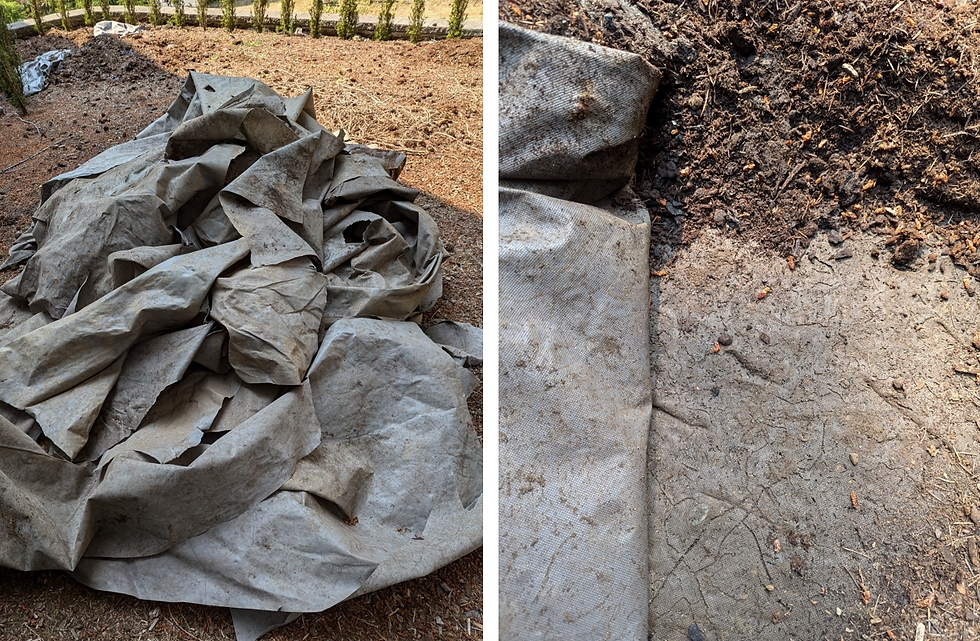
Penn State Extension describes their removal process: use a utility knife to cut the fabric into manageable strips, then pull them up while trying not to damage plant roots that have grown through.[3]
You’ll probably need to cut around any established plants and just leave small pieces of fabric around the roots rather than disturbing them too much.
After removal, add 2-3 inches of compost to help repair the soil, then mulch normally. The soil will take time to recover but it will recover.
Option 2: Cut Holes and Add Mulch
If removal is too much work, you can punch drainage holes through the fabric (use a bulb planter or just stab it repeatedly with a digging fork), then cover everything with 4-6 inches of mulch.
This doesn’t fix all the problems but at least improves water penetration and gives you a weed-blocking mulch layer on top of the fabric. Consider it a stopgap until you can remove it properly.
Option 3: Leave It Under Rock/Stone
The one situation where landscape fabric is somewhat appropriate is under decorative rock or gravel in non-planted areas. Like pathways or areas with just a few large specimen plants.
Even then it’ll eventually fail, but if you’re not trying to grow plants in that soil and the fabric isn’t covered with organic matter decomposing on top of it, it’ll last longer.
But honestly for permanent planting beds? Just don’t use it at all.
When Things Go Wrong (And How to Fix Them)
“I’m getting weeds anyway”
Check your mulch depth. If it’s less than 3 inches, add more. If it’s thick enough, pull weeds immediately before they set seed. Every weed you let go to seed creates thousands more problems.
For persistent perennial weeds (bindweed, nutsedge, etc.), you might need the cardboard method on top of your mulch. Layer cardboard over problem areas, wet it, add more mulch. Repeat if needed.
“My plants look terrible after mulching”
Check if mulch is touching stems or trunks. Pull it back at least 2-3 inches from everything. Mulch against plant tissue causes rot.
Make sure you’re not over-watering. Mulch retains moisture so you need to water less frequently than before. Stick your finger in the soil 2-3 inches down – if it’s still moist, don’t water.
“I’ve got fungus growing in my mulch”
This is actually normal and healthy. That’s decomposition happening – exactly what you want. The fungi are breaking down the mulch and releasing nutrients.
But if you have mushrooms popping up everywhere and it bothers you, just kick them over. They’re temporary and harmless to plants.
“Mulch is washing away on slopes”
Use larger chunk mulch on slopes – nuggets instead of shredded material. Or create small terraces/berms to hold mulch in place. You can also use jute netting or landscape staples initially until plants fill in.
What Actually Matters Most
After trying basically everything and reading way too many research papers on mulch, here’s what I think actually matters:
-
Skip the fabric entirely – Especially for permanent plantings. It causes more problems than it solves.
-
Use 3-4 inches of organic mulch – This is the sweet spot for weed control plus soil improvement. Less isn’t enough, more can cause problems.
-
Cardboard method for tough situations – New beds, aggressive weeds, lawn conversion. Works great and breaks down instead of polluting.
-
Refresh mulch yearly or every other year – When it decomposes down to 2 inches, add more. That decomposing lower layer is feeding your soil.
-
Keep it away from plant stems and trunks – This kills more plants than anything else with mulching.
The research is pretty clear on this stuff. Universities that have actually studied it long-term – Washington State, Penn State, NC State, UC system, Michigan State – they all come to the same conclusion. Organic mulch works better than landscape fabric for basically everything except temporary situations under inorganic materials.
Is organic mulch more maintenance than fabric? Technically yes, you’re adding more every year or two. But that “maintenance” takes like 30 minutes per bed and you’re improving your soil while you do it, not destroying it.
Meanwhile landscape fabric is this whole nightmare of weeds growing on top of it, roots growing through it, plants declining because the soil underneath is dying, and eventually you’re spending days trying to remove it. Hard pass.
Just use mulch. Keep it 3-4 inches deep. Pull the occasional weed that pops up before it goes to seed. Your soil, your plants, and your back will all thank you.
Sources
[1] Shahzad, A., et al. (2019). Carbon dioxide and oxygen exchange at the soil-atmosphere boundary as affected by various mulch materials. Soil and Tillage Research. https://www.sciencedirect.com/science/article/abs/pii/S016719871930580X
[2] Chalker-Scott, L. The Garden Professors. Landscape fabric – a cautionary tale. https://gardenprofessors.com/landscape-fabric-a-cautionary-tale/
[3] Stivers, L. Penn State Extension. Putting an End to My Landscape Fabric Nightmare. https://extension.psu.edu/putting-an-end-to-my-landscape-fabric-nightmare
[4] Enroth, C. University of Illinois Extension. (2021). The disadvantages of landscape fabric. https://extension.illinois.edu/blogs/good-growing/2021-06-25-disadvantages-landscape-fabric
[5] Bratcher, A. NC State Cooperative Extension. (2023). Knowing Better: The Appropriate Use of Landscape Fabric. https://lee.ces.ncsu.edu/2023/02/knowing-better-the-appropriate-use-of-landscape-fabric/
[6] Cost data compiled from: LawnLove, HomeGuide, LawnStarter, Fixr. (2024-2025). Mulch and landscape fabric cost comparisons.
[7] Sobhani, Z., et al. (2021). Microplastic pollution in the environment: A review. Frontiers in Environmental Science.
[8] Environmental Science & Technology. (2018). Microplastics in terrestrial ecosystems. https://www.sciencedirect.com/science/article/abs/pii/S0269749124010819
[9] Science Direct Review. Impact of long-term conventional and biodegradable film mulching on microplastic abundance in soil. https://www.sciencedirect.com/science/article/abs/pii/S0269749124010819
[10] UC Ventura Extension. An Alternative Weed Control – Mulching. https://ceventura.ucanr.edu/Com_Ag/Subtropical/Citrus/Weeds/An_Alternative_Weed_Control_-_Mulching_/
[11] University of Saskatchewan. Mulch and soil nitrogen. https://gardening.usask.ca/articles-and-lists/articles-healthysoils/mulch-and-soil-nitrogen.php
[12] Oklahoma State University Extension. (2025). Mulch a multi-purpose matter in the landscape. https://extension.okstate.edu/articles/2025/mulch_landscape.html
[13] Taylor & Francis Online. (2025). The potential and differences between mulch and organic matter in reducing drought stress. https://www.tandfonline.com/doi/full/10.1080/23311932.2025.2454342
[14] Cregg, B. Michigan State University Extension. Mulch madness. https://www.canr.msu.edu/news/mulch_madness
[15] University of Saskatchewan. Mulch and soil nitrogen. https://gardening.usask.ca/articles-and-lists/articles-healthysoils/mulch-and-soil-nitrogen.php
[16] Oregon State University. Myth vs. reality: What’s the truth behind some common gardening practices? https://news.oregonstate.edu/news/myth-vs-reality-what’s-truth-behind-some-common-gardening-practices
[17] University of New Hampshire Extension. (2019). Do pine trees and pine needles make soil more acidic? https://extension.unh.edu/blog/2019/10/do-pine-trees-pine-needles-make-soil-more-acidic
[18] Penn State Extension. Mulching Landscape Trees. https://extension.psu.edu/mulching-landscape-trees
[19] University of Maryland Extension. Mulching Trees and Shrubs. https://extension.umd.edu/resource/mulching-trees-and-shrubs
[20] Rutgers NJAES. Problems With Over-Mulching Trees and Shrubs. https://njaes.rutgers.edu/fs099/
[21] Mississippi State University Extension. How to Mulch. https://extension.msstate.edu/blog/how-mulch
[22] Arborist Now. How to Properly Mulch Around Trees. https://arboristnow.com/news/How-to-Properly-Mulch-Around-Your-Trees/
[23] Multiple sources. Cardboard weed suppression effectiveness data.
[24] Clemson Extension. (2025). How to Use Cardboard in the Landscape: Benefits and Drawbacks. https://hgic.clemson.edu/how-to-use-cardboard-in-the-landscape-benefits-and-drawbacks/
[25] Brooklyn Botanic Garden, Cornell Extension. Cardboard decomposition timeline data.
[26] SARE Study FNE10-677. Earthworm populations under cardboard mulching.
[27] UC Agriculture & Natural Resources. Sheet Mulching with Cardboard-Do’s and Don’ts. https://ucanr.edu/blog/under-solano-sun/article/sheet-mulching-cardboard-dos-and-donts
[28] Cornell Cooperative Extension. Sheet mulching best practices.
[29] Brooklyn Botanic Garden. Newspaper mulching guidelines.
[30] NC State Extension. Newspaper safety for gardens – organic inks confirmed.