Tulip Bulb Planting Guide: Best Time & Depth for Success
So every fall I get this question from at least three neighbors – “when should I plant my tulip bulbs?” And every year I’m like, “you should have started like two weeks ago.”
September planting isn’t some random gardening tradition. There’s actual science behind why this timing works, and honestly once you understand it, a lot of other bulb stuff starts making sense too.
The short version: planting bulbs in September gives them warm soil for root growth, then the cold winter period they absolutely need to make flowers. Miss this window and you’re basically fighting against plant biology.
The Whole Vernalization Thing (Which Is Less Boring Than It Sounds)
Here’s what I didn’t understand for years – spring bulbs like tulips and daffodils literally cannot bloom without winter cold. It’s not just that they tolerate cold, they require it.
There’s this process called vernalization where 12-16 weeks of temperatures between 35-48°F triggers biochemical changes in the bulb that form flower buds.[1] Research published in BMC Plant Biology showed that cold temperatures activate specific genes (FT genes they’re called) that function as chemical signals for flowering.[2] Without adequate cold exposure, these genes stay dormant and bulbs either don’t bloom or you get these sad stunted flowers on short stems.
When September nights drop to the 40-50°F range, soil is still warm from summer – typically 50-60°F – which encourages root development without triggering top growth.[3] Soil temps need to stay above 40°F for proper root formation, and bulbs need roughly six weeks of growing time before the ground freezes.[4]
Miss this window and your bulbs go into winter with weak root systems that can’t support good spring blooms. I learned this the hard way when I planted tulips in November one year. They came up but looked pathetic.
The Carbohydrate Story Is Actually Kind of Fascinating
During summer dormancy, bulbs store energy as starch. When cold temperatures arrive, that starch gradually converts to sucrose through hydrolysis, which provides the energy needed for dormancy release and spring growth.[5]
A study in BMC Genomics tracked this transformation in lily bulbs and found that total soluble sugars initially increase during cold treatment before being consumed to fuel spring growth.[5] This also explains why bulbs contain everything they need to bloom once – they spent the previous growing season stockpiling energy.
University of Minnesota Extension points out there’s technically no need to fertilize bulbs for their first bloom, though adding phosphorus at planting depth helps establish the root system for future years.[6]
Which Bulbs to Plant Now and How Deep (Because Depth Actually Matters)
The general rule everyone quotes is plant bulbs at a depth equal to 2-3 times their height, measuring from the bottom of the bulb.[7] So a two-inch tulip bulb goes five to six inches below the surface.
But honestly some sources recommend deeper. Cornell Cooperative Extension suggests 6-8 inches for tulips and daffodils, which has the added benefit of deterring squirrels who rarely dig beyond six inches.[8]
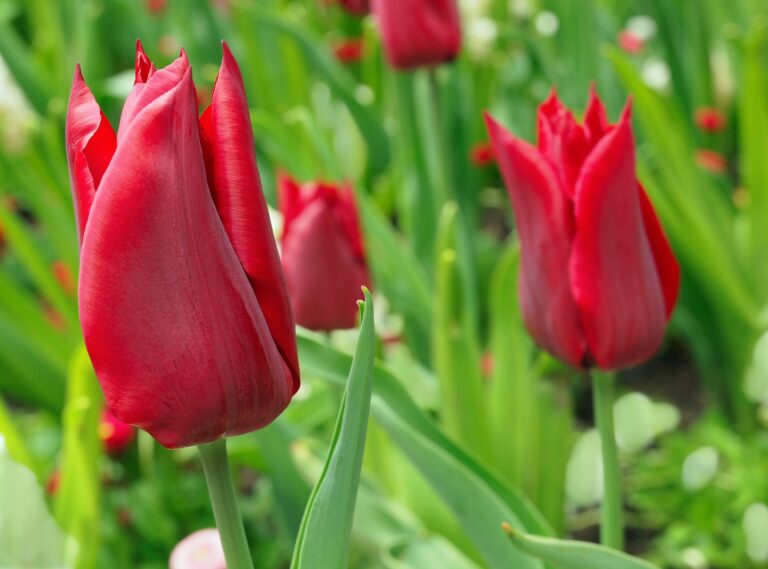
Tulips (The Divas of the Bulb World)
Plant: 6-8 inches deep, 4-6 inches apart, Zones 3-8
Tulips are finicky about timing. The Royal Horticultural Society actually recommends waiting until November for tulips since cooler weather significantly reduces risk of tulip fire (Botrytis tulipae), this devastating fungal disease.[9]
Unlike most spring bulbs, tulips often decline after their first spectacular year and may need replanting every 3-4 years. Darwin Hybrids and species tulips perennialize better than the showy cultivars that look amazing in catalogs.
Daffodils (The Reliable Ones)
Plant: 6-8 inches deep, 4-6 inches apart, Zones 3-9
These are the workhorses of spring bulbs – plant them once and they’ll return reliably for decades. Their natural toxicity makes them completely resistant to deer, rabbits, and rodents, which is honestly amazing if you have wildlife problems.
The RHS recommends getting daffodils in the ground by September’s end when soil temps still support vigorous root establishment.[10] Allow daughter bulbs to remain attached when planting, and resist the urge to braid foliage after blooming – those leaves need full sun to recharge the bulb for next year.
Hyacinths (The Fragrant Ones)
Plant: 4-6 inches deep, 4-6 inches apart, Zones 3-9
They need an absolute minimum of 12-14 weeks of cold at 40-45°F, which makes proper fall planting timing critical.[11] Handle them with gloves because they can irritate skin.
Bloom quality typically diminishes after the first year, so a lot of gardeners treat them as spectacular annuals worth replanting. I do this with hyacinths now – just accept they’re one season wonders.
Crocuses (Not Actually Bulbs But Whatever)
Plant: 3-4 inches deep, 2-3 inches apart, Zones 3-8
These are technically corms, not true bulbs, but nobody cares about that distinction except botanists. They naturalize beautifully in lawns – just delay mowing until their foliage dies back naturally, about six weeks after blooming.[12]
Snow crocus (Crocus chrysanthus) blooms earliest, often pushing through late snow. Dutch crocus (C. vernus) produces larger flowers slightly later.
Alliums (The Architectural Ones)
Plant: Varies by variety
Smaller ones like ‘Purple Sensation’ go 4-6 inches deep with 3-4 inch spacing. Giants like ‘Globemaster’ need 6+ inches depth and 12-16 inches between bulbs.[13]
The RHS notes they’re extremely drought-tolerant once established and shouldn’t receive summer irrigation, which can cause rot.[9] Plant alliums where their dying foliage will be masked by emerging perennials – the leaves yellow unattractively right as the stunning flower heads emerge.
Minor Bulbs (The Underrated Ones)
Grape hyacinths (Muscari), snowdrops (Galanthus), and Siberian squill (Scilla siberica) all plant at 3-4 inches deep with 2-3 inch spacing.[14]
These naturalize aggressively – grape hyacinths can become genuinely invasive, so consider their spreading habit when choosing locations. Snowdrops are notoriously slow from dry bulbs; many gardeners have better luck planting them “in the green” (transplanting while still in leaf immediately after flowering).
Getting the Soil Right (Don’t Skip This Part)
The single most important factor for bulb success isn’t depth or timing – it’s drainage. Every university extension source emphasizes this: bulbs sitting in waterlogged soil will rot.[15]
Missouri Botanical Garden recommends this simple test: dig a 12-inch hole, fill it with water, and observe. If water remains after an hour, you’ll need to amend the soil or choose a different location.[16]
Both Penn State Extension and University of Illinois Extension specify an optimal pH range of 6.0-7.0 for most bulbs.[7] A soil test before planting can save considerable frustration – your local cooperative extension typically offers inexpensive testing.
For phosphorus – critical for root development – timing and placement matter more than quantity. Unlike nitrogen, phosphorus doesn’t move readily through soil, so surface applications won’t reach the roots.[17] Work bone meal or superphosphate into soil at bulb depth during fall planting.
Common recipe from multiple extension sources: five tablespoons of 10-10-10 fertilizer plus two cups of bone meal per ten square feet, mixed into the planting area.[18] Crucially, don’t fertilize spring bulbs after they’ve started flowering – this actually encourages bulb rot.
The Squirrel Situation (Because It’s Always a Problem)
Squirrels are obsessed with tulips and crocuses. They’re attracted by both the bulbs themselves and the scent of freshly disturbed soil.
Most effective deterrent is simple physics: plant tulips 8-10 inches deep, below most squirrels’ digging enthusiasm.[19] Hardware cloth or chicken wire with ½-inch mesh placed both under and over the planting area creates an effective physical barrier.
Easier still: choose bulbs squirrels avoid. Daffodils, alliums, hyacinths, grape hyacinths, fritillaria, and snowdrops are all naturally unpalatable.[20]
Diseases That Can Wreck Everything
Tulip Fire (Botrytis tulipae)
This deserves special mention as one of the most devastating bulb diseases. The RHS describes symptoms as distorted, twisted emerging leaves that wither, brown lesions with water-soaked borders, and the characteristic “fire-scorched” appearance.[21]
The fungus survives in soil via black seed-like structures called sclerotia that persist for years. Prevention is straightforward but requires discipline: never plant tulips in the same location for at least three consecutive years where the disease has appeared.[21] Remove and destroy (don’t compost) any infected plant material.
Basal Rot (Fusarium)
Primarily attacks daffodils, beginning at the basal plate and progressing upward. The RHS identifies pink-white fungal growth between scales as the telltale sign.[22]
Prevention centers on drainage and careful handling – any wound to the bulb creates an entry point for the soil-borne fungus. Discard any soft or damaged bulbs before planting rather than hoping they’ll recover.
Timing by Region (Because Not Everyone Lives in Zone 5)
September planting isn’t universally ideal – it’s generally ideal, with adjustments needed based on your USDA zone.
Cornell Cooperative Extension provides this timeline:[23]
- Zones 4-5: Plant by late September to early October
- Zone 6: Until mid-October
- Zone 7: Until early November
Oregon State Extension notes gardeners in mild Pacific Northwest climates can plant as late as mid-December if soil remains workable.[24]
The underlying principle is consistent: bulbs need warm-enough soil for rooting (above 40°F) but cool-enough conditions to prevent premature sprouting.[25]
For Zone 8 and Warmer
Traditional spring bulbs face a challenge – winters may not provide adequate chilling hours. Daffodils, tulips, and hyacinths typically require 10-14 weeks of cold dormancy at temperatures below 45°F.[26]
Gardeners in warm climates often pre-chill bulbs in refrigerators (away from fruit, which emits flower-damaging ethylene gas) for 12-16 weeks before planting in December or January.[27]
Winter and Spring Care
After planting, water thoroughly to settle soil around bulbs and initiate root growth. Fall and winter rainfall typically provides adequate moisture in most regions.
Apply 2-4 inches of mulch after the ground freezes – not before – to moderate soil temperature fluctuations rather than keep bulbs warm.[28] University of Minnesota Extension specifically recommends leaf mulch, wood mulch, or clean straw.
When spring arrives and shoots emerge, resume watering if rainfall is scarce – about one inch per week through the bloom period. Deadhead spent flowers to prevent seed formation, which drains energy from the bulb, but leave foliage intact until it yellows naturally, typically 6-12 weeks after flowering.[29]
For bulbs you want to multiply, University of Illinois Extension suggests broadcasting 5-10-5 or 5-10-10 fertilizer at 2 pounds per 100 square feet when leaves emerge in spring.[30]
Common Mistakes That Guarantee Disappointment
Planting upside down rarely kills bulbs – most will send roots down and shoots up regardless – but it wastes energy and delays emergence. The pointed end goes up; if you can’t tell, plant sideways and let the bulb sort itself out.
Planting too shallow exposes bulbs to temperature swings, attracts digging pests, and is a primary cause of “daffodil blindness” (healthy foliage but no flowers).[31] Err on the side of depth rather than shallowness.
Forgetting to water after planting leaves bulbs surrounded by air pockets rather than soil contact, delaying root establishment during the critical pre-freeze window.
Treating all bulbs identically ignores significant differences in chilling requirements, moisture preferences, and longevity. Species tulips naturalize while hybrid tulips decline; daffodils tolerate diverse conditions while fritillarias demand perfect drainage.
What Actually Matters Most
After years of planting bulbs, here’s what I’ve figured out really matters:
Timing matters – Start in early September, not October
Drainage is everything – Bulbs in wet soil = dead bulbs
Plant deep enough – Deeper than you think, especially for tulips
Choose the right bulbs for your zone – Check chilling requirements
Protect from squirrels – Or plant stuff they won’t eat
Let foliage die naturally – Those leaves are recharging the bulb
Some bulbs just aren’t worth the effort in certain climates. If you’re in Zone 9 and trying to grow tulips without pre-chilling, you’re fighting a losing battle. Sometimes better to choose bulbs that actually work in your region.
The research backs up what experienced gardeners figured out through trial and error – proper timing, adequate chilling, good drainage, and appropriate depth make the difference between spectacular spring displays and disappointment.
Plant them in September when soil conditions are ideal, give them the winter cold they need, and you’ll get those amazing spring blooms that make all the fall work worthwhile.
Sources
[1] Purdue University Extension. Fall-Planted Bulbs. https://www.purdue.edu/hla/sites/yardandgarden/fall-planted-bulbs/
[2] Zhang, Y., et al. (2019). Crosstalk in the darkness: bulb vernalization activates meristem transition via circadian rhythm and photoperiodic pathway. BMC Plant Biology. https://pmc.ncbi.nlm.nih.gov/articles/PMC7027078/
[3] Lawn Love. When to Plant Bulbs in Fall. https://lawnlove.com/blog/when-to-plant-bulbs-in-fall/
[4] Penn State Extension. Bulbs, Corms, Rhizomes and Tubers. https://extension.psu.edu/programs/master-gardener/counties/chester/how-to-gardening-brochures/bulbs-corms-rhizomes-and-tubers
[5] Zhang, Y., et al. (2019). Carbohydrate metabolism in lily bulbs during vernalization. BMC Genomics. https://pmc.ncbi.nlm.nih.gov/articles/PMC7027078/
[6] University of Minnesota Extension. Forcing Bulbs for Indoor Winter Color. https://extension.umn.edu/news/forcing-bulbs-indoor-winter-color
[7] Penn State Extension. Bulbs, Corms, Rhizomes and Tubers. https://extension.psu.edu/programs/master-gardener/counties/chester/how-to-gardening-brochures/bulbs-corms-rhizomes-and-tubers
[8] Cornell Cooperative Extension. How to Grow Bulbs. https://cceoneida.com/resources/a-factsheet-on-bulbs
[9] Royal Horticultural Society. Bulbs: Planting Tips. https://www.rhs.org.uk/plants/types/bulbs/planting
[10] Royal Horticultural Society. Bulbs: Planting Tips. https://www.rhs.org.uk/plants/types/bulbs/planting
[11] The Old Farmer’s Almanac. How to Plant and Care for Hyacinths. https://www.almanac.com/plant/growing-hyacinth-muscari
[12] Gardening Know How. Crocus Flower Care. https://www.gardeningknowhow.com/ornamental/bulbs/crocus/growing-crocus.htm
[13] Missouri Botanical Garden. Flowering Bulbs Fact Sheet. https://www.missouribotanicalgarden.org/Portals/0/Gardening/Gardening%20Help/Factsheets/Flowering%20%20Bulbs17.pdf
[14] Missouri Botanical Garden. Flowering Bulbs Fact Sheet. https://www.missouribotanicalgarden.org/Portals/0/Gardening/Gardening%20Help/Factsheets/Flowering%20%20Bulbs17.pdf
[15] Penn State Extension. Bulbs, Corms, Rhizomes and Tubers. https://extension.psu.edu/programs/master-gardener/counties/chester/how-to-gardening-brochures/bulbs-corms-rhizomes-and-tubers
[16] Missouri Botanical Garden. Flowering Bulbs Fact Sheet. https://www.missouribotanicalgarden.org/Portals/0/Gardening/Gardening%20Help/Factsheets/Flowering%20%20Bulbs17.pdf
[17] University of Illinois Extension. Planting Bulbs. https://extension.illinois.edu/flowers/planting-bulbs
[18] Missouri Botanical Garden. Flowering Bulbs Fact Sheet. https://www.missouribotanicalgarden.org/Portals/0/Gardening/Gardening%20Help/Factsheets/Flowering%20%20Bulbs17.pdf
[19] Family Handyman. Things I Wish I Knew Before Planting Fall Bulbs. https://www.familyhandyman.com/article/knew-before-planting-fall-bulbs/
[20] Brent & Becky’s. How to Protect Your Bulbs from Squirrels. https://brentandbeckysblog.com/blogs/news/how-to-protect-your-bulbs-from-squirrels
[21] Royal Horticultural Society. Tulip Fire Disease. https://www.rhs.org.uk/plants/types/bulbs/planting
[22] Royal Horticultural Society. Bulb Diseases. https://www.rhs.org.uk/plants/types/bulbs/planting
[23] Cornell Cooperative Extension. How to Grow Bulbs. https://cceoneida.com/resources/a-factsheet-on-bulbs
[24] Oregon State University Extension. Plant Spring-Blooming Bulbs in Fall. https://extension.oregonstate.edu/news/plant-spring-blooming-bulbs-fall-years-low-maintenance-color
[25] South Dakota State University Extension. Forcing Tender Bulbs Indoors. https://extension.sdstate.edu/forcing-tender-bulbs-indoors
[26] Gardening Know How. Chill Period For Bulbs. https://www.gardeningknowhow.com/ornamental/bulbs/bgen/chilling-flowering-bulbs.htm
[27] Grow Organic. How to Vernalize Tulips in Zones 8+. https://www.groworganic.com/blogs/articles/how-to-vernalize-tulips-and-other-fall-planted-flower-bulbs-in-zones-8-and-above
[28] University of Minnesota Extension. Forcing Bulbs for Indoor Winter Color. https://extension.umn.edu/news/forcing-bulbs-indoor-winter-color
[29] New York Botanical Garden. Successful Bulb Cultivation. https://libguides.nybg.org/c.php?g=654974&p=4597805
[30] University of Illinois Extension. Planting Bulbs. https://extension.illinois.edu/flowers/planting-bulbs
[31] Missouri Botanical Garden. Flowering Bulbs Fact Sheet. https://www.missouribotanicalgarden.org/Portals/0/Gardening/Gardening%20Help/Factsheets/Flowering%20%20Bulbs17.pdf