Asian Needle Ants: Identification, Stings & Control Guide
Look, I’m gonna be straight with you. Most invasive ant articles either downplay the risks or turn into full-on panic mode. But after digging through actual scientific studies and talking to people who’ve dealt with these ants, the truth is somewhere in the middle – and way more interesting than the clickbait headlines suggest.
Asian needle ants (Brachyponera chinensis) are spreading across the U.S., and unlike fire ants that announce their presence with giant mounds, these guys sneak around in the damp, shaded spots where you’re probably working in your garden. The sting? It’s brutal. And for some people, it can trigger serious allergic reactions. But here’s the really concerning part most articles skip over: these ants are quietly displacing native species that actually help your garden, and that’s messing with entire ecosystems.
What Makes Asian Needle Ants Different (And Why You Should Care)
Here’s something that threw me when I first researched this – Asian needle ants aren’t just another invasive pest. They’re actually breaking some rules that most invasive ants follow.
Most invasive ants love disturbed habitats. They move into your lawn, your driveway cracks, areas where humans have already messed things up. Asian needle ants? They’re invading pristine forests. Scientists found established colonies in Great Smoky Mountains National Park at high elevations where you’d never expect an invasive species to thrive.[1] That’s not supposed to happen.
The scientific name changed a few times, which is why you might see them called Pachycondyla chinensis in older articles. Back in 2014, taxonomists did this big revision and moved them to the genus Brachyponera.[2] Not super important unless you’re trying to look up research, but it explains why the names are all over the place.
Physical Identification (Because “Small and Dark” Isn’t Helpful)
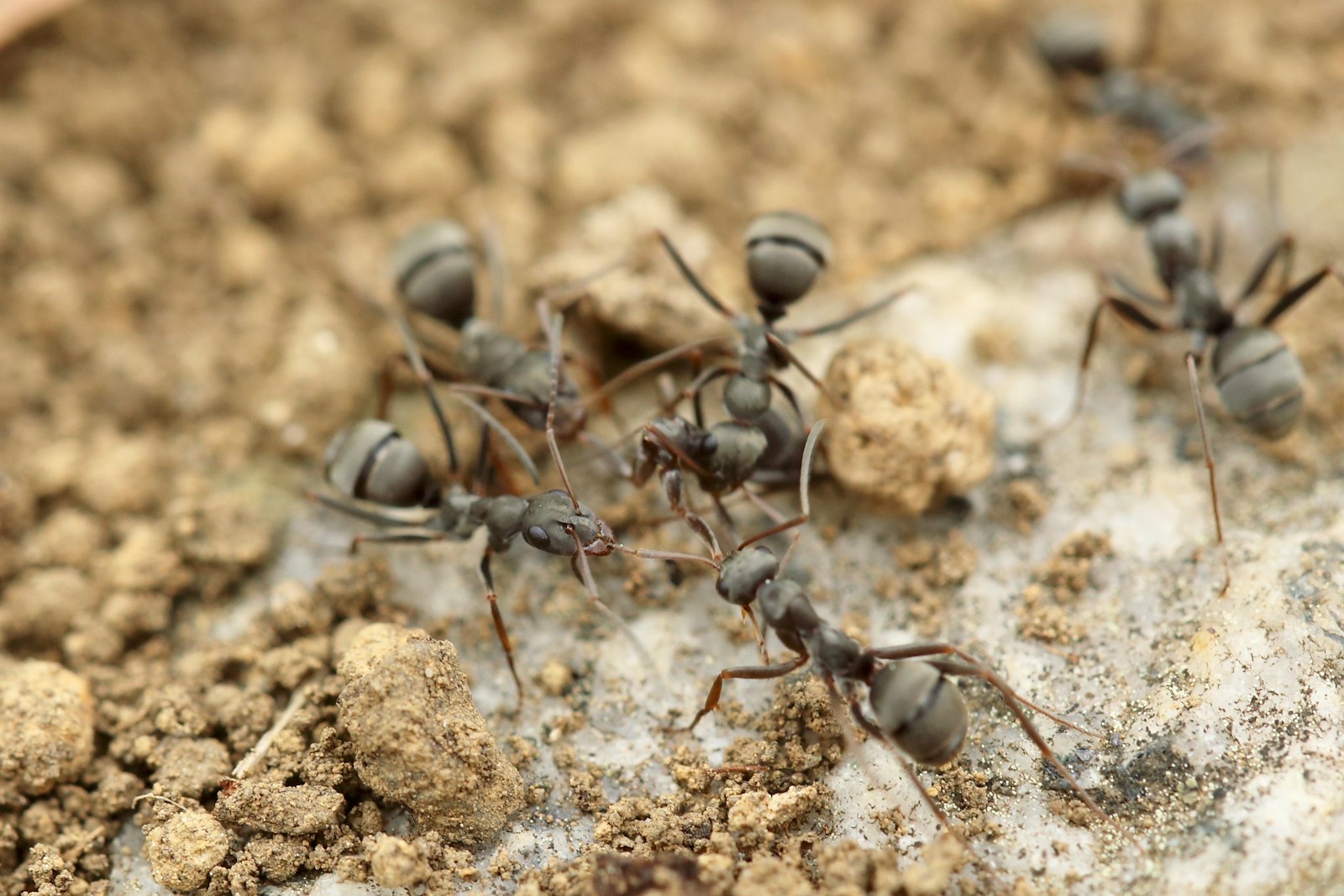
They’re about 4-5mm long – roughly the size of a grain of rice.[3] The body is dark brownish-black and shiny, but here’s the key identification trait: orange-brown tips on the legs, antennae, and mandibles. That contrast between the dark body and lighter appendages is your first clue.
The other dead giveaway is that conspicuous stinger sticking out from the lower rear abdomen when they’re agitated.[4] Most ants you can’t even see the stinger. With these guys, it’s right there.
Here’s a quick test if you find ants in a jar and you’re not sure what they are: Asian needle ants cannot climb smooth surfaces.[5] Put them in a glass jar and they’ll stay at the bottom, scrambling around uselessly. Other ants march right up the sides.
Where They Came From and How Far They’ve Spread
These ants originated in East Asia – Japan, China, Korea, Taiwan.[6] First discovered in the U.S. back in 1932 in Georgia, but they probably arrived even earlier through shipping docks.[7] For decades, nobody really paid attention. They were just… there.
Then around 2006, researchers started noticing something weird. People were showing up to emergency rooms with severe allergic reactions to ant stings, and it wasn’t fire ants. That’s when Asian needle ants got flagged as an actual public health concern.[8]
Fast forward to 2025, and they’re confirmed in over 20 states:[9]
Heavy infestations: North Carolina, South Carolina, Georgia, Virginia, Maryland, Tennessee
Established populations: New York, Connecticut, Rhode Island, Massachusetts, Alabama, Mississippi, Kentucky, Arkansas, Florida, Texas
Recent confirmations: Louisiana (2025), Indiana (2022), Washington State
They’re still spreading too. Recent research shows they’re expanding their range north and west, probably helped along by climate change making more areas suitable for them.[10]
The Sting (And Why It’s Worse Than You Think)
Okay so here’s where it gets real. I’ve read way too many firsthand accounts of people getting stung, and the descriptions are remarkably consistent: sharp, burning pain that persists for 30+ minutes and often comes and goes over several hours.[8]
Unlike fire ant stings that create those characteristic pustules the next day, Asian needle ant stings don’t form blisters. The pain is more intense initially but the visible reaction is usually less dramatic – just redness and maybe some localized swelling.[11]
The Venom Breakdown
Scientists have identified the major components in the venom:[12]
- Pac c 3 (23 kDa protein) – the main allergen, similar to yellow jacket venom
- Multiple IgE-binding proteins ranging from 12-58 kDa
- Histamines, phospholipases, and neurotoxic peptides
What’s particularly nasty is that the venom has high cross-reactivity with yellow jacket venom, which means if you’re allergic to yellow jackets, you’re at higher risk for severe reactions to these ants.[13] But here’s the kicker – there’s minimal cross-reactivity with fire ant venom, so fire ant immunotherapy won’t help you.[14]
Allergic Reactions: The Numbers Are Concerning
In a study of 25 sting victims in South Carolina:[8]
- 80% had local reactions (swelling <5cm, redness, recurring pain)
- 12% had minor reactions
- 8% had large-local reactions (swelling >5cm, severe hives, symptoms lasting up to 2 weeks)
But the really alarming stat comes from a Korean study in an ant-infested area: 2.1% of sting victims experienced systemic allergic reactions, including full anaphylaxis.[15] That’s about 40% higher than fire ant anaphylaxis rates.
And 23.3% of people living in infested areas showed positive skin tests to the venom, even if they’d never been stung.[15] That means nearly a quarter of people are walking around sensitized without knowing it.
Signs of Anaphylaxis (This Is Important)
If you get stung and experience any of these, use your EpiPen and call 911 immediately:
- Hives spreading beyond the sting site
- Swelling of lips, tongue, or throat
- Difficulty breathing or wheezing
- Rapid or weak pulse
- Dizziness or fainting
- Nausea or vomiting
- Feeling of impending doom
The problem is there’s no commercial immunotherapy available specifically for Asian needle ant allergy.[16] If you know you’re at risk, carrying an epinephrine auto-injector is your best option.
Why Native Ecosystems Are in Trouble
Here’s the part that gets me worked up. The stings are bad, but the ecological damage these ants cause is potentially way worse for the long-term health of forests and gardens.
Displacing Keystone Species
In invaded areas, populations of Aphaenogaster rudis – a keystone seed-dispersing ant – have dropped by 96%.[17] Let me put that in perspective. These native ants are responsible for dispersing seeds of dozens of woodland wildflowers. We’re talking about trilliums, bloodroot, violets, wild ginger – the spring ephemerals that make forest understories beautiful.
Research shows a 70% reduction in seed removal in areas where Asian needle ants have taken over.[18] And here’s where it gets worse: Asian needle ants don’t pick up the slack. They don’t disperse seeds. They’re predators, not mutualists.
The Domino Effect
When seed-dispersing ants disappear, you get:
- Reduced plant diversity – Plants that depend on ants for dispersal decline
- Changed forest composition – Affects everything from insects to birds to mammals
- Disrupted nutrient cycling – Native ants turn soil and move organic matter differently
One USDA researcher put it bluntly: “Parts of the fabric of nature kind of fall apart” when these native ants are removed.[19]
Even Beating Argentine Ants
In North Carolina, researchers documented the first case of another species successfully pushing back Argentine ants – another notorious invader.[20] From 2008 to 2011, Argentine ants dropped from 99% to 67% of monitored sites, while Asian needle ants increased from 9% to 32%.
The mechanism? Cold tolerance. Asian needle ants emerge in early March while other ants are still dormant. They get first access to food and territory. When you can outcompete both native species and other invasives, that’s when you know you’ve got a problem.
Where They Hide (And Why You Keep Missing Them)
Unlike fire ants with their obvious mounds, Asian needle ants are sneaky. They nest in:[21]
- Leaf litter – especially in damp, shaded areas under trees
- Rotting logs and stumps – both above and below ground
- Under rocks, pavers, bricks – anywhere with consistent moisture
- Mulch beds – particularly wood mulch that stays moist
- Railroad ties and landscape timbers – old weathered wood is prime real estate
- Dead standing trees – winter nests go inside dead trees or several inches underground
The nests themselves are polydomous, meaning one colony has multiple interconnected nest sites.[22] So killing one nest doesn’t eliminate the colony. You might have 20-30 satellite nests spread across your yard.
Colony sizes vary wildly. In winter/early spring, you might find 200 workers and 5 queens per nest. By mid-summer, most nests are queenless with only 20 workers each, but the colony has fragmented into way more nests.[23]
What Actually Works for Control (Based on Science, Not Pinterest)
Alright, let’s talk about what research shows actually works. Because I’ve seen some truly wild recommendations online that have zero scientific backing.
Professional-Grade Control
The most-studied approach comes from NC State research:[24]
- Hydramethylnon (Maxforce Complete, Amdro) – Showed “nearly complete population reductions” within 1 day of treatment in field trials. This is the gold standard based on peer-reviewed research.
- Fipronil (Termidor) – Effective for perimeter treatments and nest drenches
- Indoxacarb (Advion) – Works well in protein-based baits; Asian needle ants are predators so protein baits outperform sugar baits
The Baiting Problem
Here’s why traditional ant baiting often fails with this species: They don’t use pheromone trails.[25] Instead, they use this bizarre “tandem carrying” behavior where a scout physically picks up another worker and carries it to the food source.
This means:
- Insecticide spreads through the colony slowly
- You need higher concentrations than with trail-following ants
- Bait must be placed exactly where foragers are active, not broadcast randomly
The 2023 Breakthrough
There was actually a really cool study published in Pest Management Science that found adding termite cuticular extracts to baits increased uptake by 2x and reduced colony size by 50% faster.[26] Since Asian needle ants are specialist termite predators, this makes total sense. Commercial products incorporating this aren’t available yet, but it’s promising.
What Doesn’t Work
- Sugar baits – They’re predators. Protein baits work much better.[27]
- Killing individual nests – Colony fragments. You need to treat the whole area.
- Osage oranges (hedge apples) – Iowa State tested this old folk remedy. Doesn’t work. Spiders literally build webs on the fruits.[28]
- Essential oils and “natural” repellents – No peer-reviewed evidence for Asian needle ants specifically
DIY Approaches That Might Help
If you’re going the DIY route:
Protein-based commercial baits:
- Amdro Fire Ant Bait (hydramethylnon)
- Advion Ant Gel (indoxacarb)
- Terro Ant Bait (borax-based, less effective but safer around pets)
Application strategy:
- Find active foraging areas (check under objects in damp shade)
- Apply bait within 6 inches of where you see activity
- Don’t broadcast – targeted placement is critical
- Recheck in 3-4 weeks and retreat if needed
- Start treatments in April; peak activity July-August
Barrier treatments:
- Bifenthrin (Talstar) around foundation perimeters
- Lasts 60-90 days
- Apply before peak season
Prevention (The Stuff That Actually Matters)
Honestly, control is marginally effective and costly. Prevention is where you want to focus energy.
Habitat Modification
Remove hiding spots:
- Clear leaf litter from foundation perimeter
- Stack firewood at least 20 feet from house, off ground
- Remove old stumps, rotting logs, landscape timbers
- Replace wood mulch with stone or reduce mulch depth to <2 inches
Manage moisture:
- Fix drainage issues
- Reduce irrigation near foundation
- Clean gutters so water doesn’t pool
Exclusion
- Seal cracks in foundation
- Weather-strip doors and windows
- Install door sweeps
- Caulk around utility penetrations
The Reality Check
NC State Extension is pretty blunt about this: “No formalized management recommendation exists” and control is “marginally effective.”[29] They recommend management rather than eradication.
Which honestly makes sense when you realize you’re dealing with supercolonies that can span acres with hundreds of interconnected nests. Unless you’re treating your entire neighborhood simultaneously, you’re fighting a losing battle.
Should You Be Worried?
Real talk: it depends where you live and what you’re doing.
Low concern:
- You’re in an area without confirmed populations
- You don’t garden in damp, shaded areas
- You’re generally not allergic to insect stings
Moderate concern:
- Confirmed populations in your state
- You do a lot of yard work
- Kids or pets spend time in wooded areas
High concern:
- Known infestations in your neighborhood
- You have a history of insect sting allergies
- You work professionally in landscaping or forestry in affected areas
The anaphylaxis risk is real but relatively low (2.1% of sting victims). Fire ants are still way more likely to cause problems for most people just due to sheer numbers and aggressive behavior.
But the ecological impact? That concerns me more. When you’ve got a 96% reduction in keystone native ant species, that’s not just about stings anymore. That’s about forest health decades from now.
What’s Happening Right Now (2025 Update)
Some recent developments worth knowing:
- Louisiana confirmation (June 2025): First confirmed via iNaturalist in southern Louisiana.[30] Researchers suspect they’ve been there for years but went unnoticed.
- Great Smoky Mountains supercolonies (2025): Species distribution models show they’re established at some of the highest elevations documented for this species in North America.[31]
- Climate change projections: Models predict a 75% increase in suitable North American habitat by 2050, with expansion into Canada and the upper Midwest.[32]
- European arrival (2022): First confirmed European population in Naples, Italy. Given how they spread in the U.S., Europe could see similar range expansion.[33]
The Bottom Line
Asian needle ants are here to stay. Eradication isn’t realistic. What you can do:
- Learn to identify them – Dark body, orange-brown legs and antennae, can’t climb glass
- Modify your habitat – Remove moisture sources, clear hiding spots, reduce leaf litter
- Protect yourself – Wear gloves when working in damp shaded areas, especially under objects
- Target control efforts – If treating, use protein baits with proven active ingredients, placed exactly where ants are active
- Carry an EpiPen if you’re allergic – And know the signs of anaphylaxis
- Report sightings – Help scientists track the spread
The ecological stuff is honestly what keeps me up at night more than the stings. When you start losing native seed-dispersing ants on a massive scale, you’re looking at long-term changes to forest composition that affect way more than just ants.
But hey, at least now you know what you’re dealing with. That’s more than most gardening articles are gonna tell you.
Sources
[1] Kanes et al. (2025). “Species Distribution Models Characterize the Invasion Status of the Asian Needle Ant.” Ecology and Evolution. https://onlinelibrary.wiley.com/journal/20457758
[2] Schmidt CA, Shattuck SO (2014). “The Higher Classification of the Ant Subfamily Ponerinae.” Zootaxa 3817:1-242. https://www.biotaxa.org/Zootaxa/article/view/zootaxa.3817.1.1
[3] USDA Forest Service (2021). “Asian Needle Ant: An Invasive Stinging Ant.” Science Update SRS-SU-143. https://www.srs.fs.usda.gov/pubs/su/su_srs143.pdf
[4] Purdue University Plant & Pest Diagnostic Laboratory (2022). “Asian Needle Ant.” https://ag.purdue.edu/department/btny/ppdl/whats-hot/_docs/2022/asian-needle-ant.html
[5] NC State Extension. “Asian Needle Ant.” https://entomology.ces.ncsu.edu/asian-needle-ant/
[6] AntWiki. “Brachyponera chinensis.” https://www.antwiki.org/wiki/Brachyponera_chinensis
[7] Smith MR (1934). “A third revision of the ponerine ants of the genus Ponera Latreille.” Annals of the Entomological Society of America. https://academic.oup.com/aesa
[8] Nelder MP et al. (2006). “Emergence of the introduced ant Pachycondyla chinensis as a public health threat in the southeastern United States.” Journal of Medical Entomology 43:1094-1098.
[9] Florida Entomologist (2018). “Global and Temporal Spread of the Taxonomically Challenging Invasive Ant Brachyponera chinensis.” https://bioone.org/journals/florida-entomologist/volume-101/issue-4/024.101.0402/
[10] Bertelsmeier C et al. (2013). “Climate Change May Boost the Invasion of the Asian Needle Ant.” PLOS ONE. https://journals.plos.org/plosone/article?id=10.1371/journal.pone.0075438
[11] California Department of Food and Agriculture. “Brachyponera chinensis: Asian Needle Ant Pest Rating.” https://blogs.cdfa.ca.gov/Section3162/?p=3223
[12] Lee EK et al. (2009). “Characterization of the major allergens of Pachycondyla chinensis.” Clinical & Experimental Allergy 39:602-607. https://pubmed.ncbi.nlm.nih.gov/19178543/
[13] Kim SS et al. (2001). “Anaphylaxis caused by Pachycondyla chinensis: demonstration of specific IgE and IgE-binding components.” Journal of Allergy and Clinical Immunology 107:1095-1099. https://pubmed.ncbi.nlm.nih.gov/11398091/
[14] Jeong et al. (2016). “Component-resolved diagnostics for hymenoptera venom allergy.” International Archives of Allergy and Immunology. https://pmc.ncbi.nlm.nih.gov/articles/PMC5588610/
[15] Cho YS et al. (2002). “Prevalence of Pachycondyla chinensis venom allergy in an ant-infested area in Korea.” Journal of Allergy and Clinical Immunology 110:54-57. https://pubmed.ncbi.nlm.nih.gov/12110820/
[16] Thermo Fisher Scientific. “Insect Venom Allergen Facts, Symptoms, and Treatment.” https://www.thermofisher.com/allergy/us/en/allergen-fact-sheets/insect-venom.html
[17] Rodriguez-Cabal MA et al. (2012). “Disruption of ant-seed dispersal mutualisms by the invasive Asian needle ant.” Biological Invasions. https://link.springer.com/journal/10530
[18] Spicer Rice E, Silverman J (2013). “Propagule pressure and climate contribute to the displacement of Linepithema humile by Pachycondyla chinensis.” PLOS ONE. https://journals.plos.org/plosone/
[19] USDA Forest Service Science Update SRS-SU-143 (2021). https://www.srs.fs.usda.gov/pubs/su/su_srs143.pdf
[20] Guénard B, Dunn RR (2010). “A new (old), invasive ant in the hardwood forests of eastern North America.” PLOS ONE. https://journals.plos.org/plosone/
[21] Animal Diversity Web, University of Michigan. “Pachycondyla chinensis.” https://animaldiversity.org/accounts/Pachycondyla_chinensis/
[22] Gotoh A, Ito F (2008). “Annual and daily activity patterns of Brachyponera chinensis.” Insectes Sociaux 55:98-104. https://link.springer.com/journal/40
[23] AntWiki. “Brachyponera chinensis – Colony Structure and Reproduction.” https://www.antwiki.org/wiki/Brachyponera_chinensis
[24] NC State Extension. “Asian Needle Ant Management.” https://entomology.ces.ncsu.edu/asian-needle-ant/
[25] Guénard B, Silverman J (2011). “Tandem carrying as a novel foraging strategy in ants.” Naturwissenschaften. https://link.springer.com/journal/114
[26] Buczkowski G (2023). “Termite cuticular extracts improve bait acceptance in the Asian needle ant.” Pest Management Science. https://pubmed.ncbi.nlm.nih.gov/23156173/
[27] Bednar DM, Silverman J (2011). “Use of termites as a springboard in invasive success by the Asian needle ant.” Insectes Sociaux. https://link.springer.com/journal/40
[28] Burke Museum, University of Washington. “Myth: Spider Repellants.” https://www.burkemuseum.org/collections-and-research/biology/arachnology-and-entomology/spider-myths/myth-spider-repellants
[29] NC State Extension. “Asian Needle Ant Management Recommendations.” https://entomology.ces.ncsu.edu/asian-needle-ant/
[30] LSU AgCenter (June 2025). “Moving Lines on the Map: The Asian Needle Ant Found in Southern Louisiana.” https://www.lsuagcenter.com/articles/page1750951347561
[31] Kanes et al. (2025). “Species Distribution Models.” Ecology and Evolution. https://onlinelibrary.wiley.com/journal/20457758
[32] Bertelsmeier C et al. (2013). PLOS ONE. https://journals.plos.org/plosone/article?id=10.1371/journal.pone.0075438
[33] Phys.org (March 2022). “The worrying arrival of the invasive Asian needle ant in Europe.” https://phys.org/news/2022-03-invasive-asian-needle-ant-brachyponera.html
Additional Research Consulted:
- Virginia Tech ENTO-29NP (March 2023). https://ext.vt.edu/
- Pest Management Professional (2023). https://www.mypmp.net/on-the-move-asian-needle-ants-brachyponera-chinensis/
- Chen et al. (2025). “Revision of Chinese Brachyponera species.” ZooKeys 1230:247-286. https://pmc.ncbi.nlm.nih.gov/articles/PMC11907243/
- Clemson Cooperative Extension HGIC 2470. https://hgic.clemson.edu/