
Coneflower Pruning: Deadheading & Cutting Back Guide
So here’s the thing about pruning coneflowers. Every gardening article you read basically says the same stuff – “deadhead regularly for more blooms” and “cut back in fall or spring.” But nobody really explains why or gets into the actual plant biology that makes this work.
I’ve been growing purple coneflower (Echinacea purpurea) for probably eight years now, and I definitely screwed up the pruning thing more than once. One year I got overzealous in late summer and cut everything back thinking I was being helpful. The plants looked pathetic for the rest of the season and barely came back the next spring. Another year I didn’t deadhead at all because I was lazy and honestly? They rebloomed anyway, just not as much.
So after messing it up enough times, I actually started reading the research on this stuff. And what I found is that some of the common advice is right, but a lot of it is oversimplified or just gets repeated because someone saw it in a blog post once.
Here’s what actually matters based on both science and real-world experience.
The Fall vs Spring Cutback Debate (And Why Spring Wins)
Okay so this is probably the biggest question everyone has – do you cut coneflowers back in fall or wait until spring?
Walk through any gardening forum in October and you’ll find people on both sides getting weirdly passionate about it. But here’s the thing: there’s actually a pretty clear answer based on what’s best for the plant AND wildlife.
Leave them standing through winter.
Penn State Extension and basically every university horticulture program recommends waiting until spring to do your major cutback.[1] The reasons stack up:
Food for birds (especially goldfinches)
American goldfinches spend serious time on dried coneflower seed heads all fall and winter, methodically pulling out seeds. If you cut everything down in September, you’re basically removing their winter food supply when they need it most.[2]
I started leaving mine up after watching goldfinches work over the seed heads for literally 20 minutes at a time. They’re not just casually snacking – those seeds are a legit food source when not much else is available.
Crown protection
That tangle of dead stems catches snow and creates this natural insulating layer over the root zone. For people in zones 3-5 this can literally mean the difference between plants coming back or winterkilling in a brutal January.[1]
Beneficial insects need somewhere to winter
Native bees often nest in hollow plant stems. NC State Extension specifically recommends cutting stems to 12-24 inches rather than ground level, then leaving them to break down naturally so these pollinators can complete their life cycles.[3]
Which is cool because you’re basically creating bee habitat just by being slightly lazy about cleanup.
Maximum energy storage
Plants keep moving nutrients from dying foliage back into roots until hard frost completely shuts down that process. Penn State says wait “until several hard frosts have killed back the tops” before cutting, giving roots maximum time to store energy for next year.[1]
When fall cutting makes sense
That said, there are some legit reasons to cut back in autumn:
Disease issues. If your plants showed aster yellows (distorted green-tinged flowers, weird tufted growth) or powdery mildew, removing that material in fall breaks the disease cycle. Wisconsin Extension is emphatic that aster yellows-infected plants need to be completely removed including roots, because infected perennials serve as disease reservoirs.[4]
Preventing self-seeding. Coneflowers seed everywhere if you let them. Ohio State notes they can “really take over a garden” left unchecked.[5] Cutting before seeds mature solves this, though you sacrifice bird food.
Tidiness preference. If a neat winter garden matters more to you than wildlife benefits, fall cutting is fine for healthy plants. The coneflowers won’t suffer – they’re pretty stoic about timing.
How Those “Sun Leaves” vs “Shade Leaves” Actually Work
Most articles don’t explain this, but it’s kinda important for understanding why coneflowers react the way they do to pruning and light changes.
Echinacea growing outdoors in full sun develops what botanists call “sun leaves” – these are structured for maximum photosynthesis in bright light with thicker cuticles and more tightly packed cells.[6]
When you suddenly move that plant into lower light (like if you transplanted it to shadier spot mid-season), those sun leaves literally can’t photosynthesize efficiently anymore. The plant drops them because they’re energy drains rather than energy producers.[6]
This is why coneflowers sometimes drop leaves if you move them even a few feet to a different light exposure. Not being dramatic, just basic plant biology.
The Right Way to Deadhead (Because Where You Cut Matters)
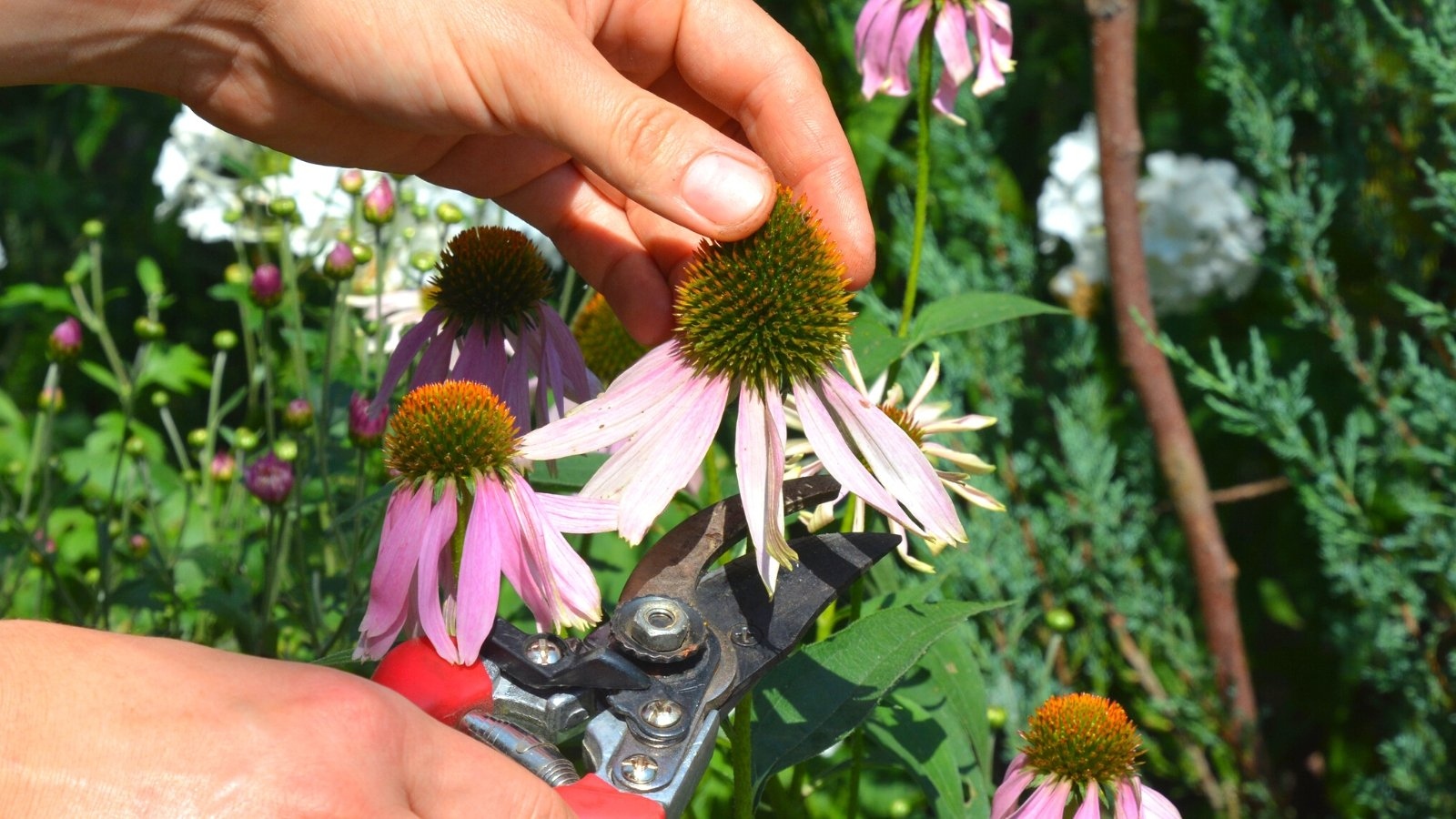
Deadheading echinacea isn’t complicated but there’s a specific technique that works better than just randomly snipping off faded flowers.
Follow the stem down to the first set of leaves
Don’t just cut the flower off at the base of the petals. Follow the whole flowering stem down to where it meets the first set of leaves, then cut just above that leaf node.[7]
Why? Because that node is where new growth emerges. University of Florida IFAS explains that cutting here often produces another flower or cluster of buds from that exact spot.[8]
If the variety only produces one flower per stem (some do), you can cut all the way back to the basal foliage.
Use bypass pruners, not anvil style
Coneflower stems are too thick and fibrous to pinch with fingers. You need actual pruners.
University of Maryland Extension confirms bypass pruners (the curved blades that slide past each other like scissors) create cleaner cuts without crushing tissue compared to anvil-style.[9] Cleaner cuts = less disease entry points.
The timing sweet spot
Deadhead consistently from first bloom through mid-August or early September. Then stop.
Give plants six weeks before your expected first frost to produce final seed heads – both for goldfinches and because the plant needs this time to fully move energy into roots for winter.[10]
What Deadheading Actually Accomplishes (It’s Not What You Think)
Here’s something interesting that most articles don’t mention: Missouri Botanical Garden notes that coneflowers usually rebloom without ANY deadheading at all.[11]
The benefit is primarily incremental rather than dramatic.
Iowa State Extension confirms deadheading promotes repeat blooms by redirecting energy from seed production.[12] Mississippi State adds it will “encourage reblooming well into fall and improve appearance.”[13]
But skip a few faded flowers and you won’t doom your display. The plant keeps making new buds regardless.
I tested this myself – one year I deadheaded religiously on half my coneflowers and ignored the other half. Both groups rebloomed. The deadheaded ones had maybe 15-20% more flowers? Noticeable but not game-changing.
So if you’re busy or traveling or just don’t feel like it, don’t stress about it.
End-of-Season Cutback: Spring Technique
When you finally do cut back (late fall after several hard frosts, or early spring before new growth), here’s the method:
Cut stems 2-3 inches above ground level. This stub marks the plant location so you don’t accidentally dig into emerging growth, and leaves the crown clearly visible.[1]
Watch for new growth in spring. Coneflowers emerge from ground level and those fresh shoots are easily damaged. If pruning in spring, do it before you see green breaking through – typically late February through early April depending on your zone.[14]
Never cut into the crown. The short woody crown sitting just at soil level is the living heart of the plant. Cut above it, not through it.
I use regular bypass pruners for a few plants but switched to hedge trimmers for my larger planting. Penn State actually recommends this for bigger areas and honestly it saves so much time.[1]
Division: Most People Do This Wrong
Echinacea can be divided every 3-6 years to prevent overcrowding according to Iowa State and Clemson.[12][15] The fibrous root system of E. purpurea makes this doable unlike taproot species.
But here’s the thing Lady Bird Johnson Wildflower Center points out that most articles skip: “Division seems to stimulate development of too many stems and too few flowers.”[16]
Their recommendation? Leave clumps alone unless truly overcrowded.
I divided some of mine a few years ago and yeah, they came back really leafy with fewer blooms the next season. Took like two years to get back to normal flowering.
If you do divide
According to NC State the technique is:[3]
- Dig up clump a few inches outside visible crown
- Knock off soil so roots are visible
- Cut into sections with at least 3 inches of fibrous roots each
- Replant immediately, water thoroughly
Spring division gives plants the full season to establish. Fall works too but risks winterkill in colder zones if roots don’t settle before freeze.
Disease Prevention Through Smart Pruning
Two problems plague coneflowers more than anything else, and both respond to proper pruning.
Aster yellows
This phytoplasma disease is incurable and causes grotesque distortion – green tufted growths from flower cones, stunted everything, eventual death.
There is no treatment. Wisconsin Extension is clear: infected plants must be completely removed including all roots and destroyed, not composted.[4]
The disease doesn’t survive in seeds though, so if you catch it mid-season you can still save seeds from infected plants – just destroy all plant material.
Powdery mildew
White dusty patches on leaves and stems. Prevention through pruning is straightforward: maintain good airflow.
Clemson Extension recommends proper spacing (18-24 inches) and thinning overly dense growth.[15] University of Minnesota adds that removing infected foliage in fall reduces fungal spore levels available next spring.[17]
I had powdery mildew issues when I planted coneflowers too close together. After spacing them out properly it basically stopped happening.
Tool Care (Because Dirty Pruners Spread Disease)
Iowa State provides clear sanitization guidance: wipe blades with 70% isopropyl alcohol (rubbing alcohol) for quick disinfection between plants.[18]
For bleach, mix one part bleach to nine parts water and soak blades at least 10 minutes, then rinse thoroughly since bleach corrodes metal.[19]
University of Missouri’s IPM program notes that old pitted blades harbor microbes even after sanitization, so consider replacing worn tools.[19]
Clean pruners:
- Before each use in spring
- Between visibly diseased plants
- After finishing for the season
Different Goals Need Different Approaches
Maximizing blooms: Deadhead consistently through summer until six weeks before first frost.
Feeding wildlife: Stop deadheading early September. Leave seed heads and stems standing through winter.
Preventing self-seeding: Deadhead every spent flower before seeds develop. Cut back hard after first frost for complete control.
Creating compact plants: Try the “Chelsea Chop” – cut stems by one-third in late May. University of Maryland Extension says this delays flowering while creating bushier, less floppy plants.[20]
Maintaining clumps: Divide overcrowded plants every 4-6 years in spring or fall. Or don’t – many experts suggest leaving well-performing clumps alone indefinitely.
What Those Hybrid Coneflowers Really Need
If you’re growing the newer orange, red, or double-flowered hybrids, adjust expectations.
Chicago Botanic Garden’s extensive cultivar trials found many hybrids with Echinacea paradoxa genetics struggle with winter wetness and are inherently shorter-lived than straight species.[21] These also typically produce sterile seeds.
For hybrids, the approach simplifies: deadhead for aesthetics throughout season, cut back late fall or early spring, plan on replanting every few years as plants decline.
Wildlife benefits of leaving seed heads apply mainly to straight E. purpurea and close relatives, not sterile hybrids.
What Actually Matters Most
After years of trial and error here’s what I’ve figured out:
1. Timing matters but isn’t critical. Fall or spring cutback both work. Spring is better for wildlife and plant energy but if you prefer tidiness, fall won’t kill them.
2. Where you cut during deadheading matters. Cut to a leaf node, not randomly. This actually affects rebloom.
3. Coneflowers are stoic. They survived thousands of years without pruning. You’re optimizing, not keeping them alive.
4. Disease is the real concern. If you see aster yellows, act fast. Everything else is pretty forgiving.
5. Wildlife benefits are real. Those seed heads feed birds all winter. Worth considering before automatic fall cleanup.
The fundamentals are simple: deadhead to a leaf node during blooming, stop in late summer for the birds, cut back to a few inches in late winter or early spring, sanitize tools.
For most gardeners the spring cutback serves both plants and wildlife best. Leave dried stems and seed heads standing through winter. Goldfinches get food, native bees get shelter, your coneflower roots get protection. Come March you can tidy everything up just as effectively.
Some leaf drop is normal with any stress or change. Ficus species drop leaves if you sneeze near them, coneflowers are way more chill than that. But they might shed a few after division or major pruning. Don’t freak out, just keep care consistent.
Common Mistakes People Make
Cutting too early in fall. Wait for several hard frosts, not just the first chilly night.
Forgetting to sanitize tools. One diseased plant can infect your whole garden via dirty pruners.
Dividing too often. Every 4-6 years max, and only if truly crowded. Otherwise leave them alone.
Expecting zero self-seeding. Even with deadheading you’ll get some volunteers. Coneflowers are prolific.
Using the wrong pruners. Dull or anvil-style crushes stems. Get sharp bypass pruners.
Cutting into the crown. That woody bit at soil level is the living plant. Cut above it.
Start early enough that you’re not rushing, take time with each cut, be thorough about disease removal, don’t overthink it. Your plants will look good and actually thrive instead of just surviving.
Sources
[1] Penn State Extension. “Cutting Down Perennials in the Fall.” https://extension.psu.edu/cutting-down-perennials-in-the-fall
[2] Missouri Botanical Garden. “Echinacea purpurea – Plant Finder.” https://www.missouribotanicalgarden.org/PlantFinder/PlantFinderDetails.aspx?kempercode=c580
[3] NC State Extension. “Echinacea purpurea – Plant Toolbox.” https://plants.ces.ncsu.edu/plants/echinacea-purpurea/
[4] Wisconsin Horticulture Extension. “Aster Yellows.” https://hort.extension.wisc.edu/articles/aster-yellows/
[5] Ohio State University BYGL. “Coneflowers Starting to Hit Peak Bloom.” https://bygl.osu.edu/node/391
[6] Ochoa de Alda, J. A. G., et al. (2024). “Indoor light environment limits photosynthetic efficiency and constrains plant species selection in buildings.” Nature Scientific Reports. https://www.nature.com/articles/s41598-024-74607-4
[7] Gardening Know How. “Deadheading Echinacea Plants.” https://www.gardeningknowhow.com/ornamental/flowers/coneflower/should-you-deadhead-coneflowers.htm
[8] University of Florida IFAS. “Pruning and Deadheading Perennials.” https://edis.ifas.ufl.edu/publication/mg371
[9] University of Maryland Extension. “Pruning Tools.” https://extension.umd.edu/resource/pruning-tools
[10] Gardening Know How. “When to Stop Deadheading Perennials.” https://www.gardeningknowhow.com/ornamental/flowers/fgen/when-to-stop-deadheading.htm
[11] Missouri Botanical Garden. “Echinacea purpurea.” https://www.missouribotanicalgarden.org/PlantFinder/PlantFinderDetails.aspx?kempercode=c580
[12] Iowa State University Extension. “Growing Coneflowers in Iowa.” https://yardandgarden.extension.iastate.edu/how-to/growing-coneflowers-iowa
[13] Mississippi State University Extension. “Purple Coneflowers for the Mississippi Gardener.” https://extension.msstate.edu/publications/purple-coneflowers-for-the-mississippi-gardener
[14] Gardening Know How. “Pruning Echinacea.” https://www.gardeningknowhow.com/ornamental/flowers/pruning-echinacea
[15] Clemson University HGIC. “Echinacea.” https://hgic.clemson.edu/factsheet/echinacea/
[16] Lady Bird Johnson Wildflower Center. “Echinacea purpurea.” https://www.wildflower.org/plants/result.php?id_plant=ecpu
[17] University of Minnesota Extension. “Powdery Mildew in Flower Gardens.” https://extension.umn.edu/plant-diseases/powdery-mildew-flower-garden
[18] Iowa State Extension. “Sanitizing Garden Tools.” https://hortnews.extension.iastate.edu/sanitizing-garden-tools
[19] University of Missouri IPM. “Cleaning and Disinfecting Pruning Tools.” https://ipm.missouri.edu/MEG/2018/1/cleaning_pruning_tools/
[20] University of Maryland Extension. “The Chelsea Chop.” https://extension.umd.edu/resource/chelsea-chop
[21] Chicago Botanic Garden. “Echinacea Cultivar Comparative Evaluation.” https://www.chicagobotanic.org/plantevaluation/echinacea-cultivars