September Deadheading Guide: What Works & What Doesn’t
So here’s the thing about deadheading in September – most gardening advice you’ll find treats it like some blanket rule that applies to everything in your garden. And honestly? That’s where people mess up.
I used to go out there every September with my pruners and just deadhead everything that looked spent. Then I’d wonder why my coneflowers weren’t feeding the goldfinches anymore, or why my roses looked stressed going into winter. Turns out there’s actually science behind when to keep deadheading and when to leave things alone.
After reading way too many research papers from university extension services (the boring kind, not blog posts), I figured out that September is this weird transition month where you need to make different calls for different plants. Some love aggressive deadheading right up until frost. Others need you to back off so they can prepare for winter.
Let me walk you through what actually matters.
Why Deadheading Works (The Science Part)
Before we get into which plants to deadhead, you gotta understand what’s happening inside the plant when you cut off those spent flowers.
When a flower finishes blooming, the plant shifts into seed production mode. Penn State Extension explains it like this: the flowering process basically shuts down, and all the plant’s energy goes into making seeds instead.[1] Which makes sense from the plant’s perspective – its whole job is to reproduce.
But here’s where it gets interesting. When you remove those spent flowers before seeds form, you’re essentially tricking the plant. South Dakota State University research found that removing blooms before seed production makes the plant think it hasn’t successfully reproduced yet, so it tries again by producing more flowers.[2]
The hormone stuff behind this is pretty cool too. Young leaves and growing shoots produce auxins that suppress lateral bud growth. When you remove spent flowers (which contain auxin-producing tissues), you release those lateral buds, and cytokinins can then stimulate cell division and new flower formation.[1]
Translation: deadheading doesn’t just make your garden look tidier – it literally changes the plant’s hormone balance to push out more blooms.
September Changes Everything Though
Here’s what most articles don’t tell you: September deadheading operates under completely different rules than summer deadheading.
University of New Hampshire Extension points out that changes in sun angle, shorter days, and cooler temperatures trigger plant hormones that induce dormancy and cold tolerance.[3] This is already starting to happen in September for most temperate climates.
So when South Dakota State says to stop deadheading when weather turns chilly because the plant will sense its reproductive efforts succeeded and start preparing for winter?[2] They’re talking about September for a lot of us.
The general rule that actually makes sense: Stop deadheading 4-6 weeks before your expected first frost date.[4] For most gardeners, that timing falls right in September or early October.
But – and this is important – this varies massively by plant type. Some plants benefit from continued aggressive deadheading through September. Others you should stop touching by early September. And some you should have stopped in August.
Let’s break down which is which.
Roses: Stop Earlier Than You Think
For hybrid teas, grandifloras, and floribundas, Iowa State University is pretty clear: stop deadheading in late summer (late August or September).[5] The University of Illinois gets even more specific – don’t cut flowers after October 1 to let plants harden off for winter.[6]
Why? Developing rose hips slows plant growth and helps prepare them for cold weather. If you keep deadheading aggressively into September, you’re basically telling the plant to keep growing new tissue right when it should be toughening up for winter.
If you’re still deadheading roses in early September:
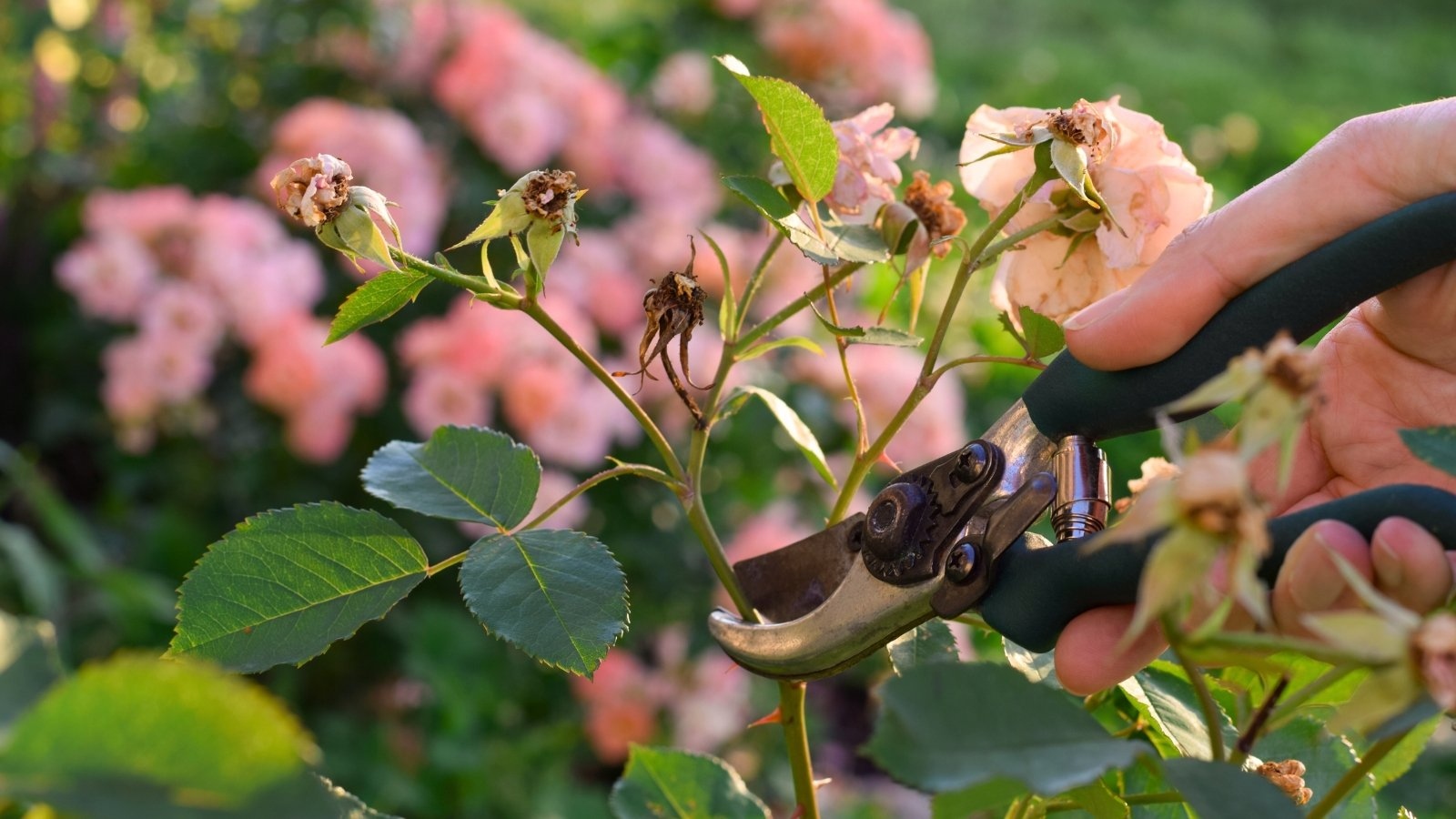
- Cut back to a five-leaflet leaf, keeping at least two five-leaflet leaves on each shoot
- Make cuts about 1/4 inch above an outward-facing bud, parallel to the leaf’s angle[5]
- For first-year roses, only remove the spent flower above the uppermost three-leaflet leaf – cutting more reduces the plant’s food production
September timing by zone:
- Zones 7-8: Light deadheading okay through early September
- Zones 5-6: Stop by mid-September at latest
- Zones 3-4: Should have stopped in late August
Shrub and landscape roses rarely need deadheading at all. Let the hips form – they look good in winter and birds eat them.
Dahlias: Keep Going Until Frost Kills Them
This is the opposite of roses. University of Missouri is emphatic about this: September is when dahlias are at their absolute peak.[7] University of Georgia Extension adds that the most beautiful dahlia flowers come from late plantings that hit their stride in September and October.[8]
The reason? Cooler September nights produce more intense, vivid colors than summer heat. And dahlias don’t need to prepare for winter the same way hardy perennials do – they’re tender tubers that you dig up anyway (or that freeze and die).
Royal Horticultural Society explains the technique: remove each spent flower by cutting back to a leaf joint lower down the stem.[9] The key skill is telling flower buds from spent flowers – buds are rounded, spent flowers get pointed and conical as they start forming seeds.
Why aggressive September dahlia deadheading matters:
- Ensures all energy goes to flowers instead of seeds
- Prolongs blooming until first frost
- Maximizes fall display when colors are most vibrant
- Cutting for vases counts as deadheading
I deadhead my dahlias every 2-3 days in September. It feels excessive but the bloom production is insane compared to when I slacked off.
After first frost damages foliage, cut stems back to 6 inches while tubers are still in ground. Penn State Extension says this stimulates tuber eye production for next season.[10]
Annuals: Weekly Maintenance Through September
Petunias need weekly attention through September until first frost. Mississippi State University Extension makes this critical point: pinch off the stalk at the base of the stem to remove seeds – the seed source is below the flower head, not in the flower itself.[11]
A lot of people miss this and just snap off the flower, leaving the seed pod. Then they wonder why deadheading isn’t working.
University of Minnesota Extension confirms you need to remove the portion below each flower where seeds develop.[12] For self-cleaning varieties like Wave petunias, you can skip this. But most regular petunias benefit from weekly deadheading through all of September.
One trick from South Dakota State: if your petunias look leggy and sad by September, shear back about one-third of overall foliage and old flowers. They’ll put out a final flush before frost.[2]
Marigolds actually perform better in September than summer in a lot of places. Mississippi State University notes that fall is great for marigolds because moderating temperatures make colors more expressive.[11] Keep deadheading weekly – remove both the flower AND the developing seed pod behind the flower head.
Zinnias respond excellently to September deadheading. Clemson University recommends cutting stems just above a bud joint to encourage nonstop blooms through late September until frost.[13] Michigan State confirms you can have blooms through late September with regular deadheading.[14]
Exception: NC State Extension points out that Profusion series zinnias don’t need deadheading because new flowers grow above old ones. Same with creeping zinnia (Zinnia angustifolia).[15]
Geraniums (Pelargoniums) should be deadheaded weekly through September until first hard frost. Iowa State describes the technique: grasp the knobby node at the base of the flower stem and snap sideways – it should break off cleanly.[5] This also reduces botrytis (gray mold) disease risk from decaying material.
Native Perennials: The Wildlife Decision
This is where you need to make a choice based on your priorities.
Coneflowers (Echinacea): Penn State Arboretum says deadheading can extend blooms well into fall, sometimes until first frost.[16] But Clemson University makes the ecological case: deadheading should be delayed because seed heads are very attractive to goldfinches in winter.[17]
NC State adds another angle: native bees nest in the dead hollow stems, so cut back dead stems to 12-24 inches and let them stand until they disintegrate naturally.[18]
Black-eyed Susans (Rudbeckia): UW-Madison Extension notes that with deadheading, flowers continue into middle of fall.[19] But Cornell University emphasizes that Rudbeckia seed heads are crucial food for goldfinches in winter.[20]
My approach: Deadhead selectively through early-to-mid September to encourage continued blooming. Then stop by mid-to-late September to allow seed head development for wildlife.
Penn State Extension actually suggests this balanced approach: “Deadhead to encourage more blooms but leave some seed heads for the birds.”[16] That way you get flowers AND help wildlife.
Proper Technique Actually Matters
Time of day: Don’t deadhead during the hottest part of day (stresses plants). Also avoid deadheading when dew is still on plants – wet cuts promote disease spread. Wait for dew to dry, then deadhead in morning or late afternoon.
Tool selection:
- Fingers/fingernails: thin soft stems on petunias, marigolds, pansies
- Sharp hand pruners: clean cuts on roses, dahlias, zinnias, coneflowers, daylilies
- Pruning scissors: precision for smaller stems
- Hedge shears: mass shearing of plants like coreopsis with abundant small flowers
Tool sterilization: University of Minnesota Extension recommends sterilizing after working on infected plants and before moving to the next plant.[21] Iowa State considers this essential between cuts when pruning diseased material.[22]
Easiest method: 70% isopropyl alcohol. Wipe or dip tools, no soaking required. For thorough disinfection, NDSU suggests Lysol All-Purpose Cleaner (undiluted, 2-3 minute soak) – won’t corrode metal and kills bacteria, fungi, and viruses.[22]
Where to cut: Iowa State specifies cutting about 1/4 inch above the next leaf, bud, or node.[5] For roses, cut parallel to the leaf’s angle. Sharp blades prevent tissue injury that could become disease entry points.
Common Mistakes That Kill Your Fall Display
Cutting at the wrong location – cutting too far down removes new growth and leaves bare stems that can’t produce flowers.[23]
Deadheading plants that shouldn’t be deadheaded in September – Penn State Extension notes that biennials like hollyhocks and foxglove need seed production to return next year. Deadheading prevents this.[1] Same with plants you’re growing for decorative seed heads (sedum, ornamental grasses) or bird food (coneflowers, black-eyed Susans in late September).
Timing mistakes – Proven Winners emphasizes that deadheading too late in fall wastes effort because shortening days and cooler temperatures work against new flower growth.[24] Also, deadheading during stressful conditions (hottest part of day, when dew is present, when plants need water) causes unnecessary stress.
Over-deadheading roses in September – Iowa State warns that removing too much foliage reduces the plant’s ability to manufacture food and may slow growth heading into winter.[5] This is the opposite of what you want when plants should be storing energy for spring.
What to Do With Deadheaded Material
Healthy material can be composted. But Iowa State cautions: don’t add diseased plant material – disease organisms may survive.[25]
Colorado State Extension elaborates: temperatures of 150-180°F are required to kill most plant disease pathogens, and most home compost piles don’t reach this level.[26]
For any plants showing disease signs, bag the material and put it in trash, not compost. Rose trimmings with black spot or fungal diseases should never enter the compost pile.
Regional Variations Matter
Zones 3-4: First frost typically September 1-15. Stop most deadheading by late August or early September. Growing season ends early – winter prep is priority.
Zone 5: First frost between September 21 and October 7. Sow True Seed recommends continuing to deadhead flowers through mid-September for a final flower display.[27]
Zone 6: First frost mid-October. Continue deadheading through most of September, but taper by month’s end.
Zones 7-9: First frost late October through November. September deadheading remains fully beneficial into October. Mississippi State University notes that marigolds are often planted specifically in September for fall color in the South.[11]
The underlying principle: Stop deadheading 4-6 weeks before expected first frost to allow perennials to redirect energy to roots, develop cold hardiness, and produce seed heads for wildlife.
A Framework for September Deadheading Decisions
Continue aggressive deadheading until frost:
- Dahlias (peak September performance)
- Marigolds (improved fall color with moderate temps)
- Petunias (until first cold snap)
- Zinnias (most varieties)
- Geraniums/Pelargoniums
- Annual bedding plants (calendula, violas)
Stop deadheading early-to-mid September:
- Roses (hybrid teas, grandifloras, floribundas) – allow hips to form
- Any perennials in zones 3-5
- Delphiniums after final flush
- Salvias in colder zones
Deadhead selectively, then stop mid-September for wildlife:
- Coneflowers (leave seed heads for goldfinches)
- Black-eyed Susans (crucial winter bird food)
- Asters (allow some seed heads)
- Phlox (balance blooms with seed production)
Never deadhead in September:
- Biennials needed for reseeding (foxglove, hollyhock)
- Plants with ornamental seed heads (sedum, ornamental grasses)
- Shrubs like spirea and butterfly bush that need dormancy signals
- Any plants specifically grown for wildlife food
What Actually Matters Most
After doing this for years, here’s what I’ve figured out really matters:
1. Know your frost date – everything else follows from this. Start counting backwards 4-6 weeks.
2. Understand each plant’s strategy – tender annuals and dahlias? Deadhead aggressively through September. Hardy perennials? Ease off to allow dormancy prep. Native perennials? Balance your aesthetic goals with wildlife needs.
3. Watch the weather – if September stays warm, you can push deadheading later. If it turns cold early, adjust accordingly.
4. Tools matter – sharp, clean tools prevent disease. Dull pruners crush stems and create entry points for pathogens.
5. Timing of day matters – morning after dew dries or late afternoon. Never during hottest part of day or when plants are wet.
The research backs up what experienced gardeners figured out through trial and error. Penn State, Iowa State, South Dakota State, and other university extension services all converge on the same principles: gradual transition from summer to fall deadheading schedules, plant-specific timing, and understanding that September deadheading serves different purposes than summer maintenance.
Some plants need your continued attention to squeeze out every last bloom before frost. Others need you to back off so they can store energy and prepare for winter. The trick is knowing which is which.
Start paying attention to your specific plants, your local frost dates, and how your garden responds. You’ll develop a feel for it. But the research gives you the framework to make smart decisions instead of just guessing.
Now get out there with your pruners. Just maybe leave those coneflower seed heads for the goldfinches.
Sources
[1] Penn State Extension. “To Deadhead or Not, Your Final Answer Is.” https://extension.psu.edu/to-deadhead-or-not-your-final-answer-is
[2] South Dakota State University Extension. “Enjoy More Flowers in Your Garden by Deadheading Regularly.” https://extension.sdstate.edu/enjoy-more-flowers-your-garden-deadheading-regularly
[3] University of New Hampshire Extension. “Dormancy: Key to Winter Survival.” https://extension.unh.edu/blog/2018/12/dormancy-key-winter-survival
[4] Proven Winners. “Deadhead or Not to Deadhead.” https://www.provenwinners.com/learn/care/deadhead-or-not-deadhead
[5] Iowa State University Extension. “Deadheading Herbaceous Ornamentals and Roses.” https://yardandgarden.extension.iastate.edu/how-to/deadheading-herbaceous-ornamentals-and-roses
[6] University of Illinois Extension. “Pruning Roses.” https://extension.illinois.edu/roses/pruning
[7] University of Missouri IPM. “Dahlia: The Forgotten Fall Flower.” https://ipm.missouri.edu/meg/2011/9/Dahlia-The-Forgotten-Fall-Flower/
[8] University of Georgia Extension. “Dahlias.” https://fieldreport.caes.uga.edu/publications/C576/dahlias/
[9] Royal Horticultural Society. “How to Grow Dahlias.” https://www.rhs.org.uk/plants/dahlia/growing-guide
[10] Penn State Extension. “The Dirt on Dahlias.” https://extension.psu.edu/the-dirt-on-dahlias
[11] Mississippi State University Extension Service. “Mari-mums are Marvelous for Fall Landscapes, Gardens.” http://extension.msstate.edu/news/southern-gardening/2020/mari-mums-are-marvelous-for-fall-landscapes-gardens
[12] University of Minnesota Extension. “Growing Petunias.” https://extension.umn.edu/flowers/growing-petunias
[13] Clemson University HGIC. “Zinnias.” https://hgic.clemson.edu/factsheet/zinnia/
[14] Michigan State University Extension. “Growing Zinnias in Your Flower Garden.” https://www.canr.msu.edu/news/growing_zinnias_in_your_flower_garden
[15] NC State Extension. “Zinnia.” https://plants.ces.ncsu.edu/plants/zinnia/
[16] Penn State Extension. “Black-eyed Susan: Beautiful and Beneficial.” https://extension.psu.edu/black-eyed-susan-beautiful-and-beneficial
[17] Clemson University HGIC. “Echinacea.” https://hgic.clemson.edu/factsheet/echinacea/
[18] NC State Extension. “Echinacea purpurea.” https://plants.ces.ncsu.edu/plants/echinacea-purpurea/
[19] UW-Madison Horticulture. “Prairie Sun Black-eyed Susan.” https://hort.extension.wisc.edu/articles/prairie-sun-black-eyed-susan-rudbeckia-hirta/
[20] Cornell University Blogs. “Rudbeckia Guide.” https://blogs.cornell.edu/fruition/2025/07/07/pg-rudbeckia/
[21] University of Minnesota Extension. “Clean and Disinfect Gardening Tools.” https://extension.umn.edu/planting-and-growing-guides/clean-and-disinfect-gardening-tools
[22] Iowa State University Extension. “How Do I Sanitize My Pruning Shears.” https://yardandgarden.extension.iastate.edu/faq/how-do-i-sanitize-my-pruning-shears
[23] Garden Design. “What is Deadheading: A Gardener’s Guide.” https://www.gardendesign.com/how-to/deadheading.html
[24] Proven Winners. “Deadheading: Removing Old or Spent Flowers.” https://www.provenwinners.com/learn/care/deadhead-or-not-deadhead
[25] Iowa State University Extension. “Composting Yard Waste.” https://yardandgarden.extension.iastate.edu/how-to/composting-yard-waste
[26] Colorado State Extension. “Composting Home Study Course.” https://extension.colostate.edu/topic-areas/yard-garden/composting/
[27] Sow True Seed. “Zone 5 Monthly Garden Calendar: Chores and Planting Guide.” https://sowtrueseed.com/blogs/monthly-garden-schedule-by-zone/zone-5-monthly-garden-calendar-chores-and-planting-guide
Additional Research Sources:
Pennsylvania Horticultural Society. “Deadheading 101: Why, When, and How to Do It.” https://phsonline.org/for-gardeners/gardeners-blog/deadheading-101
Oregon State University Extension. “How Hormones and Growth Regulators Affect Your Plants.” https://extension.oregonstate.edu/gardening/techniques/how-hormones-growth-regulators-affect-your-plants
University of Minnesota Open Textbook. “The Science of Plants: Plant Hormones.” https://open.lib.umn.edu/horticulture/chapter/4-2-plant-hormones/
National Wildlife Federation. “Native Plant Finder.” https://www.nwf.org/nativeplantfinder
For the most current information on deadheading timing for your specific region, consult your local university extension service or master gardener program.